
How Bad Science and Lies Led to the Wrongful Conviction of a Boston Woman
“During the last 18 years that Nicole has spent in prison, a dramatic shift in fire science has illuminated how old, unreliable investigation methods led to wrongful convictions of innocent people over and over again. Our hope is that now, with the benefit of all the new evidence of Nicole’s innocence—including that the fire should never have been classified as an arson at all—a court will see that justice was not done in her case.”
On April 6, 2008, a tragic early-morning fire engulfed a three-story home in South Boston, killing two young children. What happened next was a tragedy of a different kind.
Two years after the fire, in 2010, Nicole Chuminski was wrongfully convicted of arson and murder based on bad science and lies. From the start, the fire investigation lacked scientific validity. Firefighters relied on outdated methods and flawed assumptions to determine where and how the fire began, and called the fire arson without any reliable evidence to support their conclusion. In addition, a state crime lab worker claimed that there was evidence of an accelerant at the scene and on Nicole’s clothing, but there was no scientific support for his conclusions.
These initial false notions shaped everything that followed, ultimately leading to Nicole’s wrongful conviction and more than 18 years of wrongful imprisonment. Nicole was only 25 when she was arrested. The fire took the lives of her girlfriend’s two children, and this loss was devastating. Although an argument between Nicole and her girlfriend the night before the fire led police to focus on Nicole as a suspect, she always maintained her innocence. The evidence supports this—but the jury never heard it. Investigators never adequately explored the possibility that the fire was accidental. They ignored exposed wires in the charred front vestibule ceiling that could have sparked the blaze. A recent Boston Globe opinion piece, “It was one of the highest-profile murder cases in recent Boston history. Did the courts get it wrong?” highlights some of the ways that bad science impacted Nicole’s case. Finally, both witnesses who claimed Nicole was present at the scene before the fire began later admitted they had lied. Sadly, this important information did not come to light until years after Nicole’s conviction.
On February 10, 2026, Nicole’s legal team, led by New England Innocence Project Staff Attorneys Laura Carey and Stephanie Hartung, and Attorney Phil Cormier of Good Schneider Cormier Fried & Brooks, filed a Motion for New Trial in Suffolk County Superior Court. This motion demonstrates that justice was not done in the case and seeks to vacate the wrongful conviction, an important step in the fight to bring Nicole home.
A Deeper Dive Into Nicole’s Case
A Revolution in Fire Science Has Led to 95 Exonerations Since 1989
Nicole’s case was investigated and prosecuted at the cusp of a revolution in fire science that has led to the exoneration of 95 people—including nine in Massachusetts—who were wrongfully convicted of arson. Like in Nicole’s case, many of these wrongful convictions relied on outdated and unscientific fire investigation methods where evidence of an accidental fire was overlooked; bringing these facts to light helped lead to the nearly 100 exonerations, yet Nicole remains in prison today. Distinguishing arson from an accidental fire is exceptionally difficult and requires advanced knowledge of fire dynamics because fire consumes the very evidence normally used in an investigation. But most fires are investigated by firefighters who lack specialized training, even when lives and freedom are at stake. At Nicole's trial, fire investigators clung to outdated and unfounded theories about the fire’s cause and origin and presented unreliable findings of an accelerant.
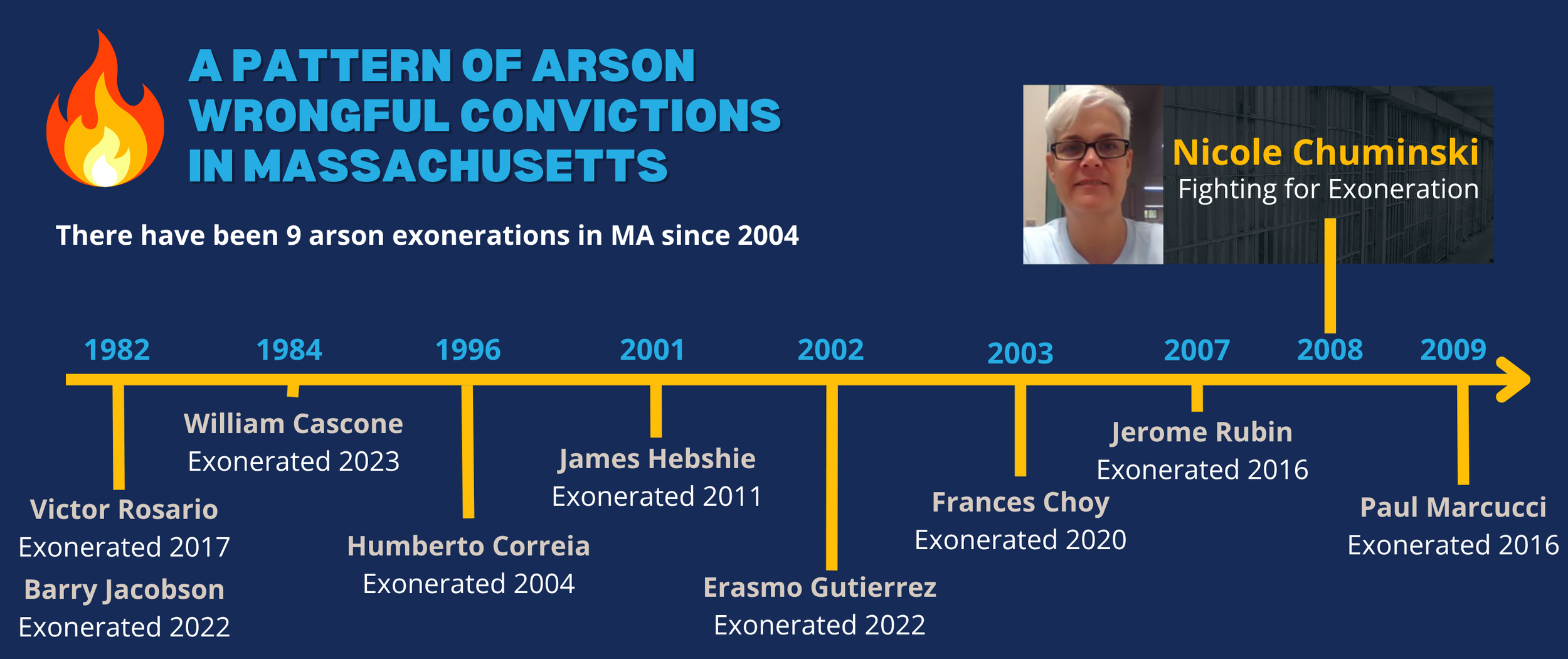
Women are Far More Likely to be Wrongfully Convicted in Cases Where No Crime Occurred
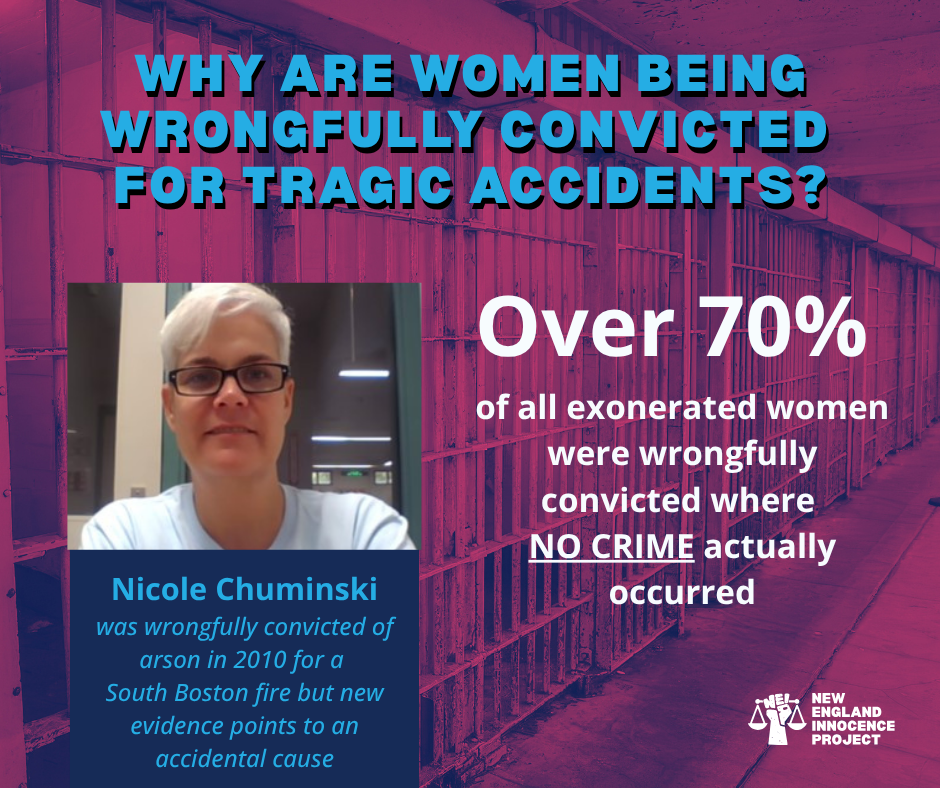
Women are twice as likely as men to be wrongly convicted in “no crime” cases, often accused of killing their loved ones, even where there is no prior criminal history. In fact, according to the National Registry of Exonerations, over 70% of all exonerations of women since 1989 involve wrongful convictions for harming or killing someone when, in reality, no crime occurred. In courtrooms across the country, these cases frequently emphasize the ways that the accused does not fit into traditional gender norms—casting judgment about how a woman is supposed to look, act, and even grieve. Nicole’s case was no exception. At her trial, prosecutors leaned on inflammatory and largely irrelevant testimony about her sexual history and LGBTQ stereotypes.
“Nicole’s case fits within a harrowing trend in the legal system where women are wrongfully prosecuted and convicted for accidental deaths. Statistics show that the large majority of cases involving exonerated women are ‘no-crime’ convictions, often stemming from misdiagnosed accidents or medical tragedies. Though the desire for a culprit following a child’s tragic death is a powerful instinct, it should not supersede the pursuit of truth.”
An Investigation Tainted by Bad Science and Lies
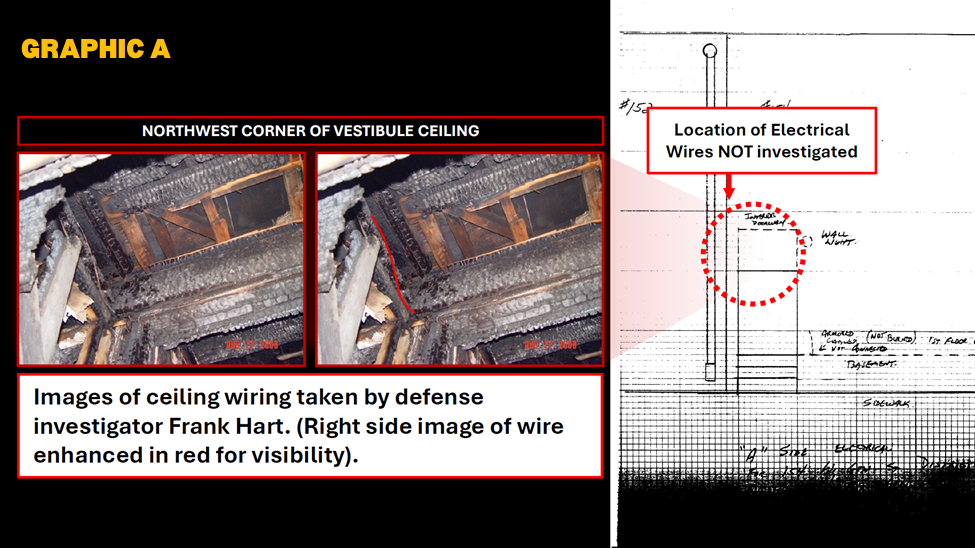
As the investigation unfolded, critical errors continued to compound. Investigators at the scene jumped to the conclusion that the fire was arson, relying on outdated and unreliable methods to determine that the fire started on the bottom step of the front vestibule. As a result of this assumption, they never investigated visible wires in the vestibule ceiling (see graphic A), an obvious potential cause. In fact, based on a review using modern scientific principles, the fire could have started anywhere inside the vestibule, including the ceiling where the wires were located. Electrical fires were very common at the time, with 56 occurring within the same three-square-mile area of South Boston alone between 2005 and 2011.

The claim that a chemical was splashed or poured at the scene to start the fire was also unreliable and should never have been presented to the jury. A detection dog that “alerted” at three locations at the scene had a troubling history of false positives—information the jury never heard—with laboratory testing showing the canine had been wrong roughly half the time. A state crime lab worker then compounded the damage. He misled the jury into believing that trace amounts of a chemical called acetone on debris and Nicole's clothing were potential evidence of arson. However, it was widely known that the same chemical occurs naturally in clothing, building materials, and even the human body. You can read more about this in a 2026 Boston Globe piece that spotlights Nicole’s case. This testimony violated the lab’s own procedures and was both false and unscientific. Notably, the same lab worker has testified as a prosecution witness in nearly half of the nine known wrongful arson convictions in MA.
False accounts placing Nicole at the scene before the fire began further compromised the investigation. Detectives zeroed in on Nicole after two witnesses—both with a motive to lie—claimed they heard her yelling and banging on their front door before the fire began. Nicole’s girlfriend and her son were inside the home when the fire started. He managed to escape, but his two sisters, who were trapped on the third floor where they had been sleeping, tragically lost their lives.
The children’s mother told police that she had been asleep on the second floor when the fire began, but new evidence shows she was not at home at all. She later admitted to two friends that she was not home when the fire broke out and felt guilty for leaving her kids alone. These admissions directly contradict what she told police and what she later testified to at trial.
Unreliable Jailhouse Snitch Testimony
The case against Nicole also involved another notoriously unreliable form of evidence: jailhouse snitch testimony. Jailhouse informants or “snitches”—witnesses who are in custody with the accused and testify about hearing incriminating statements—contribute significantly to wrongful convictions, especially wrongful murder convictions. This type of evidence is widely viewed as unreliable because incarcerated witnesses are motivated to provide helpful information to the prosecution, often in exchange for a reduced sentence or other incentives. But because discussions between informants and prosecutors are typically shrouded in secrecy, proof of an agreement can be difficult, if not impossible, to uncover. In Nicole’s case, the fact that the prosecution resorted to using this kind of unreliable evidence, including from witnesses who did not come forward until the eve of the trial, demonstrates the weakness in their case. Each of the four women who testified against Nicole stood to benefit in their own cases by cooperating with the prosecution, and one of them affirmatively admitted to requesting release in exchange for her testimony.
Next Steps in Nicole’s Case
“The conviction of any innocent person is disturbing and haunting. This is especially so in Nicole’s case where the jury was presented with a false and misleading picture that she had engaged in arson when in truth there was no reliable scientific basis for concluding that she had done so. She has paid a heavy price—nearly two decades of incarceration—for a crime she did not commit. Now is the time to rectify her wrongful conviction and give her the justice she deserves. ”
The New England Innocence Project filed Nicole’s Motion for New Trial on February 10, 2026, in an effort to overturn her conviction, but still has not received a response from the prosecution. The Suffolk County District Attorney’s Office now has the opportunity to review the new evidence and decide if it will agree to the motion or fight it. If the District Attorney’s Office opposes the motion, Ms. Chuminski has asked the court to hold an evidentiary hearing to examine all of the new evidence of innocence and grant her a new trial.
As argued in the motion, “Given the collective impact of new evidence that has come to light since trial, there is no remaining reliable evidence that Ms. Chuminski was responsible for intentionally setting the fire. Instead, what jurors would hear at a new trial would be sufficient to reasonably infer that the fire was accidentally caused by an electrical source, that there was no evidence that an accelerant was used, and no credible evidence that Ms. Chuminski was present at the home before the fire started.”
“When I was first arrested in 2008, my whole world was turned upside down. I lost everything—my girlfriend and her two kids that I loved. Everything was gone, including my freedom. I was 25 years old, and I will never get those years back. But I hope that now, with this motion, the truth will finally come out.”