
How Outdated Fire Science Led to the Wrongful Arson Conviction of Architect Robert Therrien
A fire broke out in the early morning hours of July 19, 2001, and severely damaged the historic Theatre Marketplace building in Dennis, MA. The investigation that followed, tainted by bad science and false evidence, nearly destroyed a man’s life.
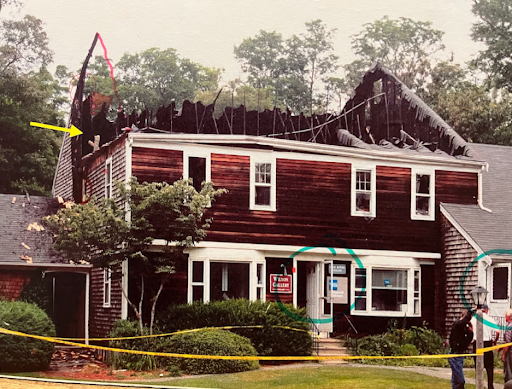
A photo of Theatre Marketplace following the fire
Architect Robert Therrien was wrongfully convicted in 2004 of setting fire to the office space he rented inside the Theatre Marketplace. No witnesses were present when the fire broke out. Investigators relied on outdated and unreliable methods to conclude the fire was intentionally set. Compounding this initial error, a chemist from the Massachusetts State Police Crime Lab said there was evidence of an accelerant at the scene, although there was no scientific support for this conclusion.
Sadly, this important information did not come to light until years after Robert’s conviction. Robert was 53 years old at the time of his arrest. He had spent years building his business, Gaffney Architects, which took on municipal projects such as the Randolph Town Hall, Halifax Police Department, and Bridgewater Public Library. Robert was stunned to find himself accused of burning down the business he had long nurtured and loved. He believed the truth would come out and the system would deliver justice, until the moment he was convicted of something he didn’t do.
“Robert’s case is yet another example of the cascade of errors we see in so many wrongful arson convictions: a misguided fire investigation based on outdated methods, false testimony suggesting the presence of an accelerant at the scene without scientific support, and a manufactured motive that cherry-picked and manipulated financial details while ignoring others. But the jury that convicted Robert wasn’t aware of any of these problems with the investigation. With the new evidence presented in his forthcoming Motion for New Trial, Robert hopes that the truth will finally come out.”
A Deeper Dive Into Robert’s Case
An Investigation Tainted by Bad Science and False Evidence
In the hours and days after the fire, Robert quickly became the prime suspect. He had worked late in his rented office, the locked area of the building where the fire broke out, and was one of the few people with access. At trial, the Commonwealth presented outdated fire “science” to show that the fire was started with “an open flame to an ignitable liquid” in the attic above Robert’s drafting room [location indicated by a yellow arrow in the photo above]. Fire investigators focused narrowly on this area because of the now-debunked belief that the location with the most damage must be where the fire originated. To shore up their theory of an intentionally set fire, the Commonwealth presented unreliable evidence of an accelerant known as “fuel oil residue” at the scene. However, new scientific analysis shows that no chemical evidence of fuel oil, or any accelerant, was actually present. Notably, the same lab worker who testified about the presence of an accelerant in Robert’s case also testified in the case of another wrongful arson conviction, NEIP client Nicole Chuminski, as well as in multiple known wrongful arson convictions in MA.
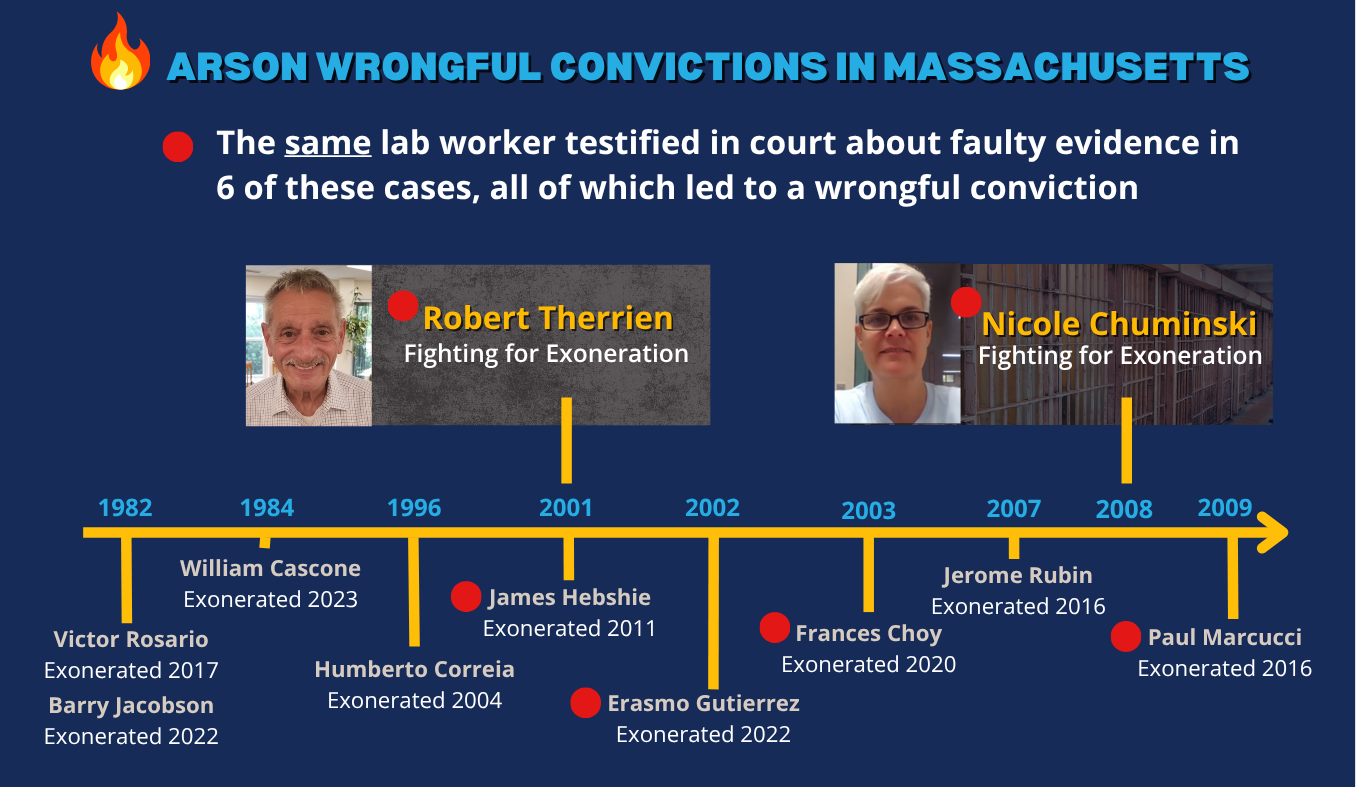
A graphic outlining six wrongful conviction cases where the same lab worker testified about false evidence
“When a conviction is built on bad science like it was in Robert’s case, the integrity of our entire legal system is compromised. The physical evidence here is unequivocal: no scientific proof of an accelerant was ever found at the scene. By examining this evidence, the court will have a vital opportunity to confront systemic misconduct, uphold scientific integrity, and ensure that the false presentation of scientific evidence never replaces the truth.”
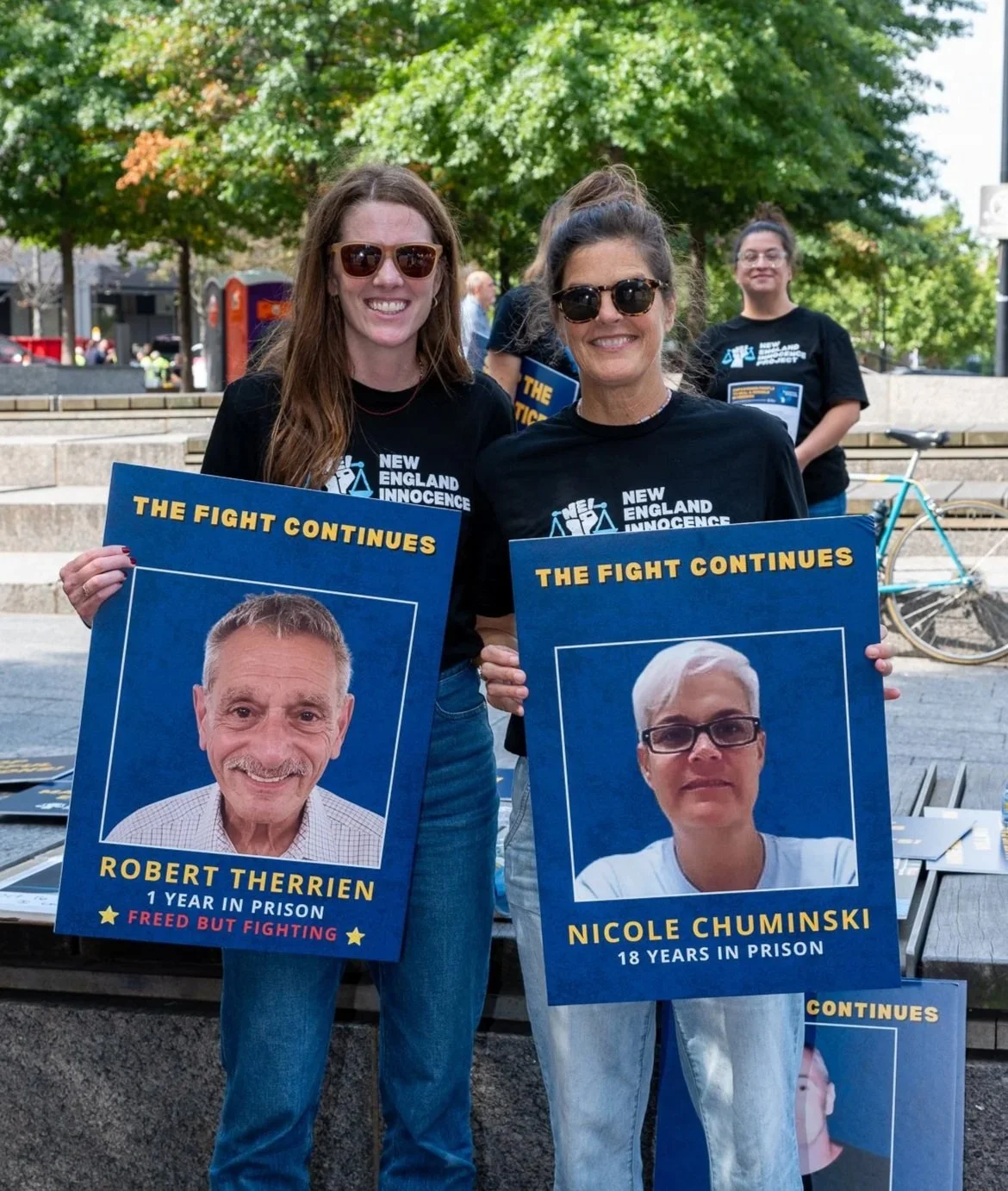
NEIP attorneys Laura Carey (left) and Stephanie Hartung hold photos of their clients, Robert Therrien and Nicole Chuminski, who were both wrongfully convicted of arson, on Wrongful Conviction Day 2026.
With the benefit of modern fire science, this fire could not be classified as arson today. Instead, potential electrical sources—including a damaged electrical outlet—which were never properly examined or investigated, were more likely to have started the fire.
Biased by the initial faulty conclusion that the fire was arson, police and prosecutors tried to bolster their case against Robert with a misleading picture of Robert’s finances, arguing that he burned down his office space to obtain insurance benefits. To support their case, they presented an accounting expert whose analysis did not follow proper accounting procedures. He not only misrepresented the value of the anticipated insurance proceeds, but also relied on inconsistent time periods for comparison of debt and income over time. His testimony painted a false picture of Robert’s financial status. Contrary to this false narrative, Robert was financially secure, had successfully run his own business for over 15 years, was in negotiations to sell the business and remain a salaried employee, and owned two homes.
A Pattern of Bad Science in Arson Exonerations
Robert’s case was investigated and prosecuted before a revolution in fire science that has led to the exoneration of 95 people—including nine in Massachusetts—who were wrongfully convicted of arson. As in Robert’s case, many of these wrongful convictions relied on outdated, unscientific fire investigation methods that overlooked or ignored evidence of an accidental fire. Distinguishing arson from an accidental fire is inherently difficult and requires advanced knowledge of fire dynamics because fire consumes the very evidence normally used in an investigation. At Robert’s trial, fire investigators used the same unscientific methodologies and theories about the fire’s cause and origin that were present in dozens of known arson exoneration cases.
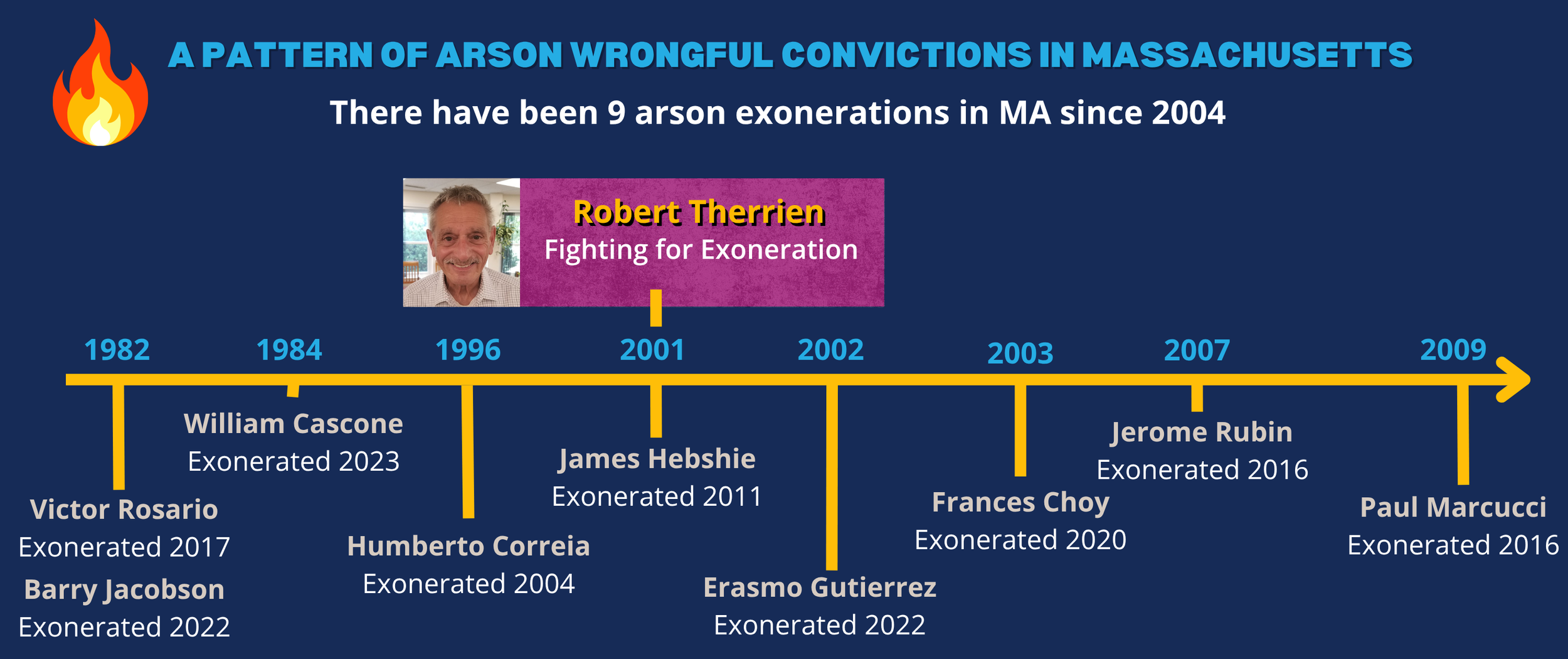
The Devastating Impact of a Wrongful Conviction
Wrongful convictions devastate individuals, families, and communities. On the night of the fire, Robert lost his entire business, Gaffney Architects, which he had spent years building. His wrongful conviction damaged his reputation and status in the community and tore apart his family. Robert was sentenced to serve two years in prison for something he didn’t do, and continues to be haunted by a harmful narrative that impacts his ability to heal, find work, and rebuild his life. While nothing can give Robert back all he has lost, bringing the truth to light can restore some sense of peace for him and his family.
“Being wrongfully convicted was like a death sentence to me. I had no hope, and everything was lost - my integrity, my business, everything I had achieved, my family. It felt like being hit by a train.”
Next Steps in Robert’s Case
Robert’s legal team, led by New England Innocence Project Staff Attorneys Laura Carey and Stephanie Hartung, in partnership with law firm partner attorneys at McDermott Will & Schulte and retired DLA Piper partner Rob Sherman, plans to file a Motion for New Trial in November 2026 to overturn his wrongful conviction by demonstrating that “justice was not done” in his case. The Attorney General’s Office, which initially prosecuted Robert’s case, recently launched a new Justice Review Unit, and our legal team has presented them with new evidence of Robert’s innocence. They now have the option to agree to the motion for new trial or fight it. If the Attorney General’s Office opposes the motion, Robert will ask the Court to hold an evidentiary hearing to examine all of the new evidence of innocence and grant him a new trial.
“In sum, the trial was marred by a cascade of errors. Absent these fundamental errors, the jury would have had a reasonable basis to conclude that the fire was an accident caused by an electrical source and not the result of arson. The errors and new evidence, taken individually or collectively, demonstrate that justice was not done in Mr. Therrien’s case, and a new trial is required.”
“This is a case that was not in the headlines or on the national stage, but was one of critical importance to one man whose life was ruined in the wake of an ill-conceived and flawed prosecution,” said Rob Sherman, former Partner with DLA Piper and NEIP pro bono counsel for Robert Therrien. “As a litigator for over 40 years, it has been an honor to work alongside the New England Innocence Project team to right this wrong and finally get justice for Robert.”
“As a team of attorneys used to working at the intersection of science and law, it was especially rewarding to apply our skills to interrogate the science used in this conviction and shed light on unreliable methods and misinterpreted results,” said Sarah Fischer, Partner at McDermott Will & Schulte and NEIP pro bono counsel. “We hope this will help achieve some measure of justice for Robert.”