
N.H. Legislators Override Veto of HB 1422
Legislators voted to eliminate the 3-year deadline for new trial motions when there is new evidence
of innocence, paving the way for more freedom in N.H., which has only had 3 exonerations since 1989
“We have a lot of cases that we couldn’t get into court before… we can now move these cases forward, which is a huge, huge win for folks who are wrongfully incarcerated here. I feel like this is the beginning of a new era for NEIP’s work in New Hampshire.”
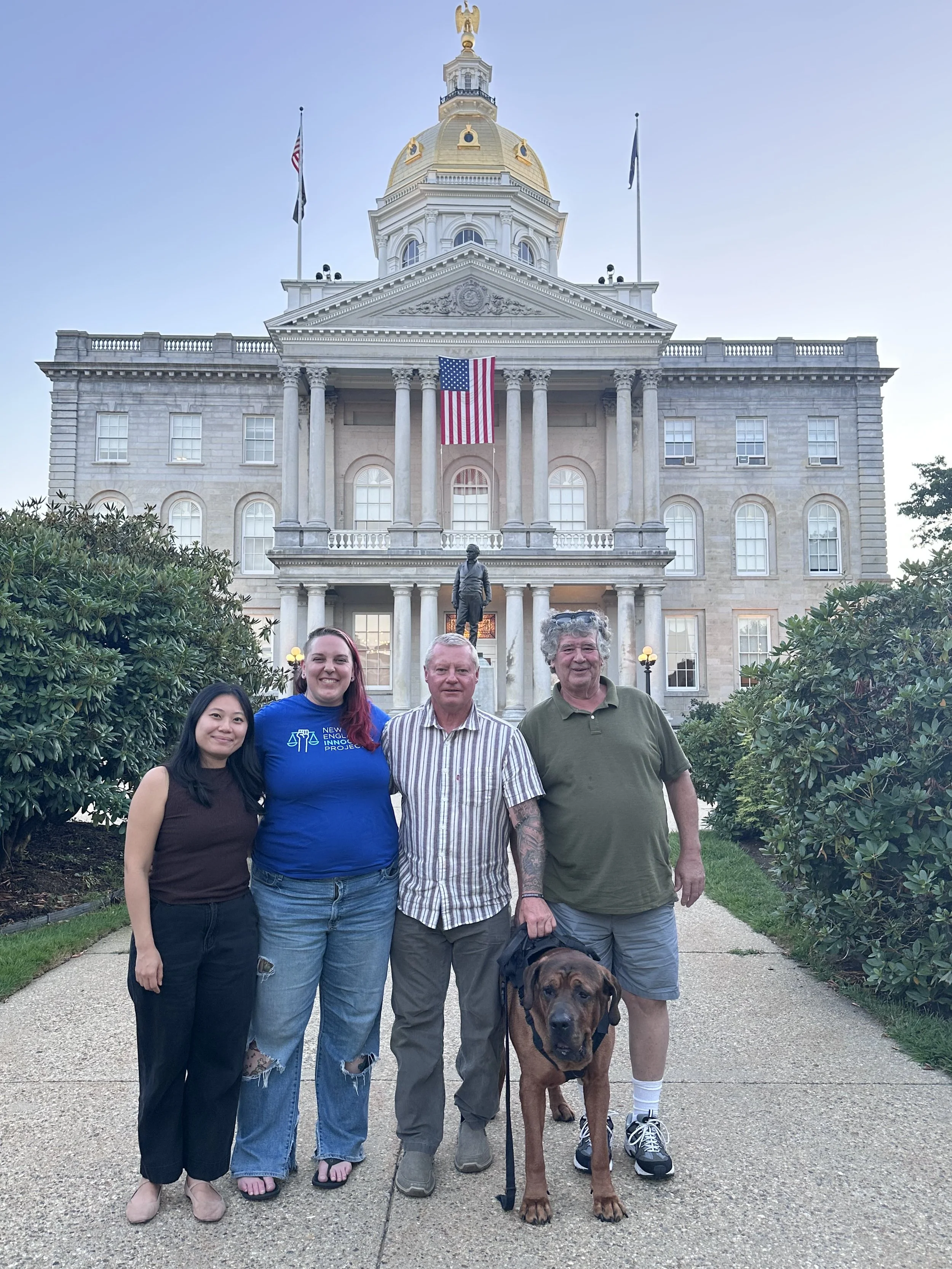
Pictured (left to right): Winnie Ye, Innocence Project in NY; Cynthia Mousseau, New England Innocence Project; exoneree Scott Hornoff; exoneree Mike VonAllmen celebrating the win in front of the New Hampshire State House in Concord on August 19, 2026.
Yesterday was a huge day in New Hampshire. A bill the New England Innocence Project, alongside the Innocence Project in NY, has been championing for several years that would eliminate the 3-year deadline for new trial requests when there is new evidence of innocence will finally become law because legislators in New Hampshire overrode Governor Ayotte’s veto of HB 1422. This paves the way for more voices to be heard in court; it helps people wrongfully incarcerated in NH to keep hope alive behind the wall, and it means a chance for more freedom and more families reunited in New Hampshire.
Thank you to everyone who helped us to #OverrideTheVeto on HB 1422. Thanks to the representatives in the House and Senate who supported this effort and to our collaborators and allies, including Winnie Ye, State Policy Advocate at the Innocence Project in NY. This proves that when we come together and fight, we win!
Why this bill is important
New Hampshire has the lowest number of exonerations in the country: only 3 since 1989, when tracking began. While some claim this is because the Granite State has an infallible criminal legal system, common sense and trends in science, technology, and law teach us otherwise. New Hampshire has a wrongful conviction problem.
In New Hampshire, only three pathways allow a wrongful conviction case to reach a court: DNA testing petitions, habeas corpus petitions, and new trial motions. Before this bill passed, all three pathways had limitations that created major obstacles for innocent people fighting for their freedom statewide.
First, DNA testing petitions are rarely helpful for our clients because the majority of our cases do not involve DNA. Second, habeas corpus petitions are only available in cases that include a provable constitutional violation. New evidence or changes in science are not constitutional violations, so they cannot be introduced through a habeas corpus petition without also having a claim of a constitutional violation. In many of our cases, we can’t prove a constitutional violation occurred, or the case did not involve one, making habeas corpus petitions another unavailable tool.
New trial motions are specifically designed to present new evidence and new science in a post-conviction setting. But before HB 1422, New Hampshire law allowed new trial motions to be filed only within 3 years of a conviction. Once those 3 years passed, petitioners were no longer able to access the court—even if new evidence of innocence arises. For example, consider a case where there is a new witness with evidence about a person’s innocence or if new arson science shows that a fire previously believed to be intentionally set was accidental, but the new evidence/science is found four years after a conviction. Without DNA or a constitutional violation, there was no legal pathway left for us to pursue for our wrongfully convicted clients in New Hampshire — until now.
Our policy efforts
We had filed a bill three times with the New Hampshire legislature, asking them to remove the 3-year deadline on new trial motions if new evidence or new science could shed light on a wrongful conviction. In all three legislative sessions, the bill has passed out of both the Senate and House but failed to reach the finish line of finalization into law. And on July 2, the latest version of the bill, HB1422, was vetoed by Governor Ayotte after being passed unanimously out of both the House and Senate.
Governor Ayotte’s veto demonstrated the incredible resistance we face in overturning wrongful convictions, and ignorance of the obstacles that are harming wrongfully convicted people.
However, on Veto Day, August 19, 2026, New Hampshire legislators voted to override the veto and pass this important, common-sense bill.
“It means we have a lot of work to do. We have a lot of cases that we couldn’t get into court before… we can now move these cases forward, which is a huge, huge win for folks who are wrongfully incarcerated here,” said Cynthia Mousseau, NH Staff Attorney, New England Innocence Project. “Today, I feel very hopeful for our work. I feel really grateful that everybody could see this bill makes a lot of sense and has strong bipartisan support at a time when bipartisan support is hard to come by. I feel like this is the beginning of a new era for NEIP’s work in New Hampshire.”
“It’s overwhelming for me to be a part of this,” said Mike VonAllmen, exoneree and advocate of HB 1422. “I’m so glad [wrongfully convicted] people now have a chance at freedom. I feel for them. I hope those folks get what I have. ”
“Every step of the judicial system failed me and my loved ones. If it wasn’t for the person responsible coming forward and confessing, I would still be in prison. And if I had lived in NH before this bill finally became law, I would have been out of luck because I was in prison for 6.5 years, and after 3 years, you wouldn’t have had the opportunity to file for a new trial, but now you do,” said Scott Hornoff, exoneree and HB 1422 advocate. “Today was the culmination of a lot of work. I testified in support of this bill that would eliminate that time limit. We came back up here cautiously optimistic, and I’m pleasantly surprised that the legislators voted to override this veto. It feels good to pay it forward because a lot of people fought for me, and they fought hard. Hopefully people will benefit from this.”