
Jason Carroll
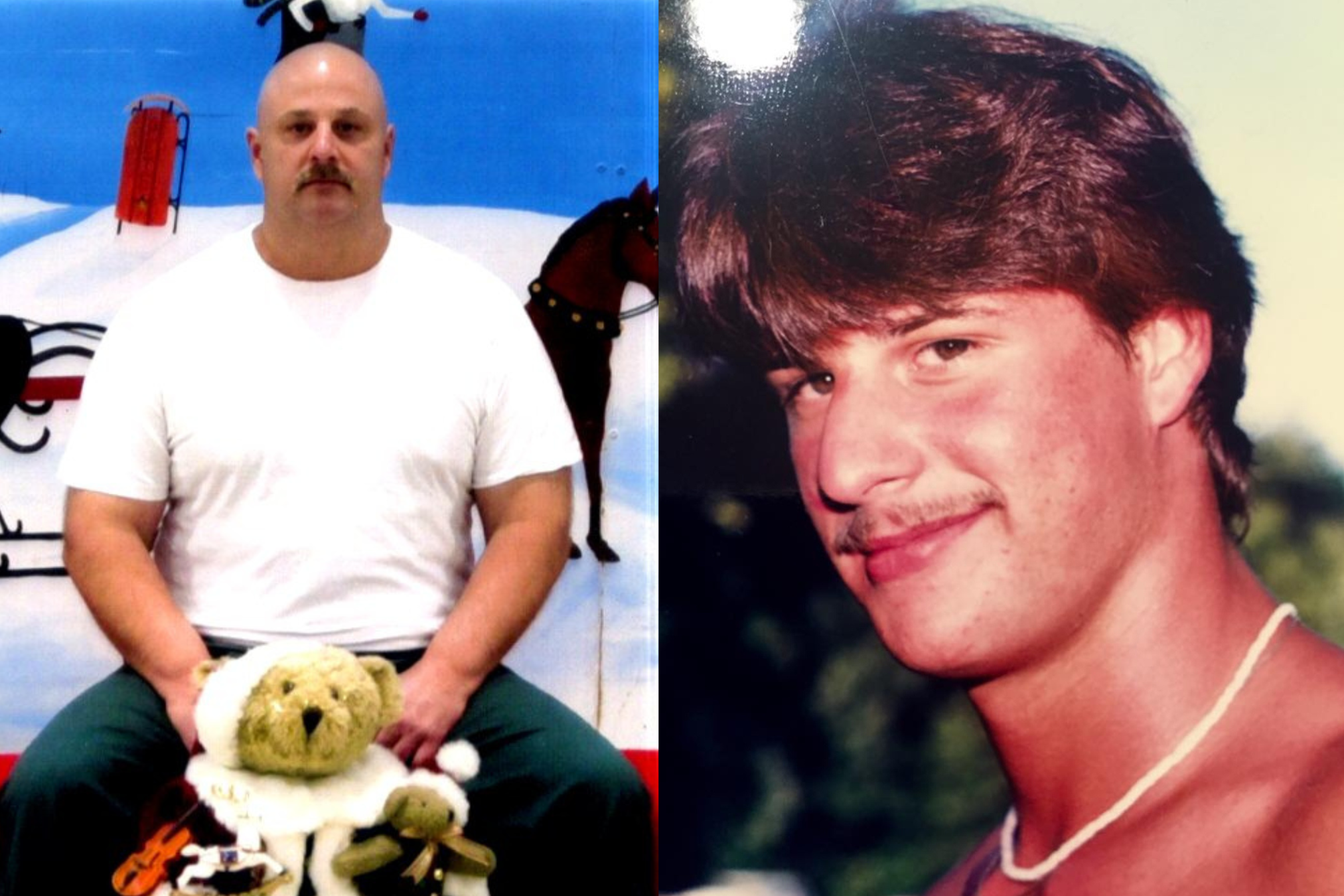
Jason before his wrongful incarceration (right) and in recent years (left).
“I have yet to meet one person who believes they would confess to a serious crime they didn’t commit. Yet, it happens all the time.”
—Cynthia Mousseau, NEIP Staff Attorney
The False Confession at the Center of Jason’s Case
Arrested at 19 years old, Jason has been in prison since 1989 for the murder of Sharon Johnson in Bedford, New Hampshire, a murder he did not commit. The only evidence linking him to the crime was his coerced confession, given at the screaming urgency of his own mother, then a police officer who says she had been promised immunity for her son if she could convince him to “talk.” Officers involved claimed it was one of the most intense interrogations they had ever witnessed. It was, as New Hampshire Public Radio Senior Reporter Jason Moon puts it, the day “a lie that refuses to die was born.”
“Our client, Jason Carroll, definitely didn’t think he would ever confess to something he didn’t do,” said Cynthia Mousseau, NEIP Staff Attorney. “And even after he told police the story they wanted to hear, hoping the truth would come out in the end, he never believed a jury would ignore the fact that his statements didn’t match the undisputed evidence in the case and convict him. But that’s exactly what happened.”
In fact, according to the National Registry of Exonerations, almost one out of three documented DNA exonerations since 1989 involved a false confession. And these statements have a tremendous impact in a courtroom. Confessions are so powerful, in fact, that juries will often discount actual physical evidence if it contradicts the confession. For example, exoneree Jeffrey Deskovic, at age 16, confessed to the rape and murder of a classmate. Even though DNA from the semen taken from the victim’s body didn’t match Jeff, the jury convicted him. Jeff wasn’t exonerated until 15 years later, when further DNA testing showed that the semen belonged to a known murderer who eventually confessed to the crime.
The Case Background
Sharon Johnson was found dead in a construction pit in Bedford, New Hampshire, in July 1988. Jason was never a suspect in the murder or even questioned about it until November of 1989. Jason was interrogated by police, including by his own mother, over a number of days for countless hours without relief. Ultimately, Jason provided a series of statements over the course of the three-day interrogation that suggested he, his coworker Tony Pfaff, and Sharon’s husband, Ken Johnson, committed the murder. He recanted his statement multiple times, both while he was giving it and afterward. In the end, he was so adamant about his recantation that he refused to repeat the falsehoods in court in order to testify against his co-defendants, even though doing so would likely have resulted in a lighter sentence.
The Facts Never Supported the (False) Confession
Jason’s statements were so inconsistent with the undisputed forensic evidence in this case that it was more probable that he was guessing in response to interrogation questions than that he had any actual knowledge. In fact, given these inaccuracies, it was shocking that Jason was ever considered a credible suspect, let alone convicted. Here are just a few examples:
In his false confession, Jason said he stabbed the victim using a small pocket knife that had a blade of about 2 ¼ inches. The wound in the victim’s back is around double that size and could not have been caused by that knife.
Jason was asked to pick Ken Johnson from a photo lineup, but he chose the wrong person because he did not know who Ken Johnson was.
Jason said he and Tony returned Sharon’s vehicle to the mall parking lot on the night of the murder, but the car was not in the mall parking lot that night and was not found until days later.
Jason said he used the alleged money he was paid for his participation in the murder-for-hire to purchase a car stereo for the truck he was using. The owner of his truck, by contrast, told police that the stereo had been installed before Jason began using it.
Tony Pfaff, Jason’s co-defendant, was acquitted of the charges, likely because the jury did not believe his ‘confession’ was true due to the substantial inconsistencies. The charges against Ken Johson, the alleged mastermind of the crime and the one who supposedly hired Tony and Jason to kill his wife, were dropped because, without Jason or Tony’s testimony, no evidence of Ken’s guilt existed. But Jason was found guilty of this crime based on the State’s story that his co-worker, Tony, offered him money to help with the murder. Jason is the only one who was ever convicted of a crime.
An Impossible Situation
In 2022, Jason was denied a petition for a sentence modification primarily because, as the judge stated, Jason would not accept responsibility for the crime, leaving Jason in an impossible situation. He could have continued the lie and perhaps would be home free right now because of it. But he told the truth and continues to be incarcerated for it.
Permission to Test for DNA
As was documented in Season 2 of NHPR’s Bear Brook podcast, “A True Crime Story,” after years of legal and investigative work led by NEIP Staff Attorney Cynthia Mousseau and a team of pro bono attorneys at Foley Hoag, in October of 2022, we were alerted to the existence of a box of case evidence in the basement of a New Hampshire courthouse, evidence we thought may have been destroyed. In the box were items that could help prove Jason’s innocence, including items from the crime scene and fingernail clippings taken from the victim. We immediately filed for permission to test the items for DNA.
A Second Box of Evidence
In December of 2023, we were scheduled for a hearing in which the court would decide whether Jason would be allowed to test the items for DNA, something the State had resisted from the beginning. However, only days before the hearing, we learned that a second box of evidence from the case had been found!
Despite having waited so long for a hearing just to decide whether we could move forward with DNA testing, we knew we needed more time not only to examine the second box but also to make sure there was no other evidence out there that might help Jason prove his innocence. It was a tough decision, but we were able to postpone the hearing and successfully argue for court-ordered searches by state and local police departments for any additional case evidence. This included providing details on where they searched and who performed the searches.
As a result of the court order, state and local police found and provided our team with hundreds of pages of documents, electronic and video recordings, and access to the second box of evidence.
After many years of searching for this evidence, we were able to ask the trial court to let us test the physical evidence for DNA, evidence that has never been tested before, to help us demonstrate what Jason has said all along: He is innocent.
Prosecutors Drop Their Opposition to DNA Testing
In a surprising reversal in April 2024, prosecutors in New Hampshire dropped their opposition and agreed to DNA test evidence in Jason Carroll’s case, 17 months after we filed our initial request for testing and only days before his scheduled court hearing on the issue.
Preliminary Results of DNA Testing
In May 2025, we finally received the preliminary results from DNA testing, which confirmed the presence of human DNA on several items connected to the murder of Sharon Johnson. There’s more work to be done to develop DNA profiles and identify a person from the evidence, but we're grateful there’s a path forward and renewed hope that the truth will come to light. Jason also has hope, perhaps for the first time in decades, that this evidence will help prove his innocence and play a crucial role in his journey to freedom.
We are inspired by our community's continued support in our fight for justice for Jason. We’re so grateful to our partners in this work, including the team at Foley Hoag and investigator John Nardizzi, as well as Jason’s sister, Jackie. We will never stop until we see Jason come home and can give Sharon Johnson’s family the closure they deserve.
More on Jason
Links
State of N.H. Drops Opposition to DNA Testing of Evidence in Jason Carroll Case
2025 Case Update: Our fight for Jason Carroll
Podcast: Jason’s Story on Bear Brook Season 2, “A True Crime Story” Podcast
Behind-the-Scenes Virtual Event of Bear Brook Season 2: “A True Crime Story”
VideoS
Status
Currently fighting for release
Age at Arrest: 19 years old
Current Age: years old
Sentence: Three consecutive sentences: 40 years to life, 6 to 15 years, 6 months
Primary Contributing Factors This list is not comprehensive.
- False Confession
NEIP’s Involvement
- Took on the case: 2019
Pro Bono Partners
- Foley Hoag
Case Investigators and Experts
- 1 Investigator
- 1 Expert on juvenile police interrogations, adolescent brain development
- 1 Expert on police practices regarding interrogation
- 1 Forensic psychologist