Commonwealth Drops Case Against Gary Cifizzari

Commonwealth Drops Case Against Gary Cifizzari
Who Was Wrongfully Convicted of Murder and
Served 35 Years in Prison for a Crime He Did Not Commit

Photo credit_ WBZ-TV.png

Worcester, MA [December 10, 2019] - The Worcester County District Attorney dropped its case against Gary Cifizzari of Taunton, Mass., who was wrongfully convicted of a 1979 murder and spent 35 years in prison for a crime he did not commit.

"Exonerations are always bittersweet,” said Radha Natarajan, co-counsel for Cifizzari and Executive Director of the New England Innocence Project.  “During 35 years of wrongful imprisonment, Gary Cifizzari endured so much and lost so much.  But today, he finally receives the justice he deserves and can celebrate the freedom he has again.  Whenever there is a wrongful conviction, it exposes errors in our criminal legal system, and we hope that this case -- and lessons from it -- can prevent future injustices."

“We are thrilled that Mr Cifizzari was rightly exonerated today. No one should spend decades behind bars for a crime they did not commit,” said Ropes & Gray litigation and enforcement partner Kirsten Mayer. “We commend the Worcester District Attorney for assenting to our motion for a new trial and concluding that the charges against Mr. Cifizzari should be dropped in the interest of justice.”

On May 31, 2019, the New England Innocence Project and a pro bono Ropes & Gray litigation team filed a motion for a new trial in Worcester Superior Court on behalf of Mr. Cifizzari. Along with his brother, Mr. Cifizzari was wrongfully convicted of the 1979 murder of his great aunt, 75-year-old Concetta Schiappa. The May 31 motion exposed newly discovered and tested DNA evidence developed from the semen and saliva on the victim’s nightgown that exonerated Mr. Cifizzari and identified Michael Giroux as the true perpetrator of the crime through a CODIS DNA match. Mr. Giroux, now deceased, was originally a suspect in the case and questioned by police, but was never charged and later went on to commit other crimes. 

In addition, the motion detailed how the Commonwealth’s case against Mr. Cifizzari was built entirely on flawed bitemark comparison testimony, which the scientific community has since condemned as lacking any scientific basis. The motion also explained how one of the Commonwealth’s original experts, Dr. Richard Souviron, has since recanted the testimony he offered at Mr. Cifizzari’s trial, which was used to convict Mr. Cifizzari.

On July 12, 2019, the court allowed Mr. Cifizzari to be released from prison after 35 years while the court considered his motion for a new trial.

Today, the District Attorney filed an assent to the motion for a new trial, and the court allowed the motion for a new trial, officially overturning Mr. Cifizzari’s conviction.   In addition, today the District Attorney filed a motion for nolle prosequi, stating that it is not in the interests of justice to prosecute Mr. Cifizzari further.

Read Gary’s full story via the National Registry of Exonerations


Select Media Coverage:

“Worcester District Attorney Drops Charges Against Gary Cifizzari in 1979 Milford Slaying”
— MetroWest Daily News

“D.A. Dismisses Murder Charge in 1979 Milford Killing” — Associated Press

”Murder Charge Dropped Against Gary Cifizzari in Killing of his 75-year-old Aunt in Milford 40 years Ago” — MassLive.com


The Unreliability of Bitemark Comparisons

Forensic science errors, which include bitemark comparisons, are a leading cause of wrongful convictions nationwide.  Yet, prosecutors are still bringing the practice into the courtroom, where it is often used as key evidence leading to a conviction.

Since the availability and use of DNA testing, which was born in the scientific community and can provide precise identifications, the wrongful convictions of innocent men and women due to faulty bitemark comparison evidence have been exposed years or even decades later. View our Bitemark Backgrounder


Additional information and research:

National Academy of Sciences: “Strengthening Forensic Science in the United States,” 2009

”Forensic Science in Criminal Courts: Ensuring Scientific Validity of Feature-Comparison Methods,” President’s Council of Advisors on Science and Technology, September 2016

”A bite mark matching advocacy group just conducted a study that discredits bite mark evidence,” Radley Balko, The Washington Post, April 8, 2005


ARC OF JUSTICE AWARD: Ropes & Gray

The New England innocence Project honored the Ropes & Gray litigation team with the “Arc of Justice” award for their pro bono partnership on Gary’s case at our inaugural storytelling event on Dec. 3, 2019 at City Winery Boston. Learn More

NEIP Honors Ropes & Gray with “Arc of Justice” Award at Inaugural Storytelling Event, Dec. 3

Ropes & Gray Pro Bono Team Recognized for its Outstanding Partnership to
Free an Innocent Man from Prison and Effect Lasting Change in the Criminal Justice System


The New England Innocence Project honored Ropes & Gray partner Kirsten Mayer and a pro bono Ropes & Gray litigation team with the 2019 ARC OF JUSTICE award at the Voices of the Innocent: Still We Rise storytelling event on December 3 at City Winery Boston.

The inaugural ARC OF JUSTICE award recognizes a New England Innocence Project partner who has demonstrated unparalleled commitment, tenacity, and courage to "bend the arc of the moral universe toward justice" for innocent people convicted of crimes they did not commit. 

The New England Innocence Project celebrates Ropes & Gray as the first recipient of this award for the firm’s partnership in helping to free Gary Cifizzari, an innocent Massachusetts man wrongly convicted for a crime he did not commit, and who was released in July 2019 after serving 35 years in prison.

“It is our distinct honor to present the inaugural 2019 ARC OF JUSTICE Award to Kirsten Mayer & the Cifizzari Team of Ropes & Gray for their fierce, compassionate, and steadfast partnership to free an innocent man from prison and effect lasting change in the criminal legal system by challenging unreliable forensic science. Through this close partnership, Ropes & Gray demonstrated tremendous perseverance pulling the arc toward justice and succeeding,” said Radha Natarajan, Executive Director of the New England Innocence Project.

While the namesake quote, “The arc of the moral universe is long, but it bends toward justice," is attributed to Martin Luther King, Jr., the concept was originally invoked by an abolitionist, Theodore Parker, who was born in Lexington Massachusetts. Recently, Former Attorney General Eric Holder added an important postscript: "The arc bends toward justice, but it only bends toward justice because people pull it towards justice. It doesn’t happen on its own."

“I am honored to accept this award on behalf of the entire team who worked to ensure that Mr. Cifizzari was justly released from prison while the Court decides his Motion for New Trial on the basis of newly discovered evidence,” said Kirsten Mayer, litigation partner at Ropes & Gray. “The firm is proud to support the critical work carried out by our colleagues at The New England Innocence Project.”


Boston Innocence Organizations Raise Awareness on International Wrongful Conviction Day, October 2

New England Innocence Project, CPCS Innocence Program, Boston College Innocence Program partner with local exonerees to talk to Boston area students about wrongful convictions

On October 2, the New England Innocence Project, CPCS Innocence Program, Boston College Innocence Program, along with thousands of people around the globe, will honor International Wrongful Conviction Day — the annual international observance dedicated to ending wrongful convictions of innocent people convicted of crimes they did not commit.

In an effort to raise awareness of the causes and remedies of wrongful convictions and to recognize the tremendous personal, social, and emotional costs of wrongful convictions for innocent people and their families, the three organizations are partnering with exonerees from New England to speak to students about wrongful convictions at 12 local high schools throughout the Boston area.  The organizations are scheduled to reach approximately 800 students in one day! 

For more school speaking events details, materials, and a list of ways the general public can get involved, visit: newenglandinnocence.org/wrongful-conviction-day

For further information, please visit iwcd.org.

Cifizzari Released After 35 Years Wrongfully Imprisoned

Gary Cifizzari of Taunton Released from Prison after Being Incarcerated for

More Than 35 Years for a Crime he did Not Commit 

WORCESTER – July 12, 2019 – The New England Innocence Project and a pro bono Ropes & Gray litigation team announced today that Gary Cifizzari of Taunton has been released after serving 35 years in prison for a crime that he did not commit.

The court’s decision today allows Mr. Cifizzari to be released while the court considers his Motion for a New Trial. Mr. Cifizzari’s release is in large part due to the strength of the evidence that he has presented in support of his Motion, which Mr. Cifizzari’s legal team filed on May 31, 2019 after newly discovered DNA evidence affirmed his innocence. Mr. Cifizzari was wrongfully convicted in Worcester County Superior Court of the 1979 murder of his great aunt, 75-year-old Concetta Schiappa. His brother Michael Cifizzari, also convicted, died in prison before the new DNA evidence could exonerate him.

“We are grateful to the Court for granting our Motion for Stay of Execution of Sentence while it decides Mr. Cifizzari’s Motion for New Trial on the basis of newly discovered evidence,” said Ropes & Gray litigation and enforcement partner Kirsten Mayer. “We’re pleased that the Court recognized the facts of Mr. Cifizzari’s case in making the decision today.”

“Today, Gary Cifizzari finally saw justice.  It took 35 years, and he never gave up hope.  We will not stop fighting for him until this wrongful conviction is overturned,” said Radha Natarajan, executive director of the New England Innocence Project.

Newly tested DNA evidence from the murder scene, including semen and saliva found on the victim’s nightgown, excludes Mr. Cifizzari and also identifies Michael Giroux as the true perpetrator of the crime through a CODIS DNA match.  In addition, the Commonwealth’s case against Mr. Cifizzari was built entirely on flawed bitemark comparison testimony, which the scientific community has since condemned as lacking any scientific basis. Mr. Giroux, now deceased, was originally a suspect in the case and questioned by police, but was never charged and later went on to commit other crimes. 

In the coming months, Mr. Cifizzari’s legal team and the Commonwealth will submit additional briefing. Going forward, Mr. Cifizzari will take small steps to start rebuilding his life after decades of wrongful incarceration, and he has a growing team of supporters that will help him do that. 

About the New England Innocence Project
The New England Innocence Project (NEIP) is a non-profit committed to correcting and preventing the wrongful convictions of innocent men and women in Massachusetts, New Hampshire, Vermont, Rhode Island, Connecticut and Maine.  Through pro bono legal and investigative services, education, systemic reform efforts, and support as exonerees rebuild their lives, NEIP is devoted to ensuring justice within the criminal legal system.  Visit New England Innocence Project at NewEnglandInnocence.org for more information and to get involved.

About Ropes & Gray
Ropes & Gray is a preeminent global law firm with approximately 1,400 lawyers and legal professionals serving clients in major centers of business, finance, technology and government. The firm has offices in New York, Boston, Washington, D.C., Chicago, San Francisco, Silicon Valley, London, Hong Kong, Shanghai, Tokyo and Seoul, and has consistently been recognized for its leading practices in many areas, including private equity, M&A, finance, asset management, real estate, tax, antitrust, life sciences, health care, intellectual property, litigation & enforcement, privacy & cybersecurity, and business restructuring. 

NEIP Receives $100K for 100 Grant from Cummings Foundation

We are excited to share that the New England Innocence Project is one of 100 local nonprofits to receive a grant of $100,000 through the Cummings Foundation’s “$100K for 100” program. We were chosen from a total of 574 applicants during a competitive review process.

Our team plans to use the funds to support the hiring of an attorney with specific expertise in forensic science for a 2-year project. This Forensic Science Justice Attorney will provide expertise on cases with complex forensic science issues in Suffolk and Middlesex Counties in both the post-conviction stage to correct wrongful convictions and the pretrial stage to prevent future wrongful convictions.

“It is our goal to bridge the gap between science and law – to bring more accuracy and reliability into the courtroom, and as a result, a sense of integrity and justice.  Without the Cummings Foundation, we would not have the resources to pilot this project, to begin exploring how specialized training could enhance our current work correcting wrongful convictions and how knowledge might actually prevent these tragedies from occurring in the first place,” said Radha Natarajan, Executive Director of the New England Innocence Project. 

In more than 70% of wrongful convictions revealed through DNA evidence, eyewitness misidentification was a factor, and in almost half (45%), there was a ‘misapplication’ of forensic science.  Through expertise in the science of memory, DNA, pathology, or a pattern-matching discipline, the Forensic Science Justice Attorney would work to address some of the greatest causes of wrongful conviction.

“We are so grateful that the Cummings Foundation is partnering with us in this visionary project that we hope will be a model for staffing forensics experts throughout our 6-state territory, ultimately helping our organization to better achieve its mission,” added Natarajan.

Learn more about the Cummings Foundation at www.CummingsFoundation.org.

New England Innocence Project Executive Director, Radha Natarajan (middle) and Treasurer, Cheryl Schaffer (left) pose at the photo booth with Cummings Foundation Trustee, Paul Casey at the reception for grant recipients in Woburn.

New England Innocence Project Executive Director, Radha Natarajan (middle) and Treasurer, Cheryl Schaffer (left) pose at the photo booth with Cummings Foundation Trustee, Paul Casey at the reception for grant recipients in Woburn.


NEIP files motion for new trial for Gary Cifizzari

DNA Match Solves 40-year-old Murder in Milford;
Affirms Local Man was Wrongfully Convicted of the Crime

New England Innocence Project and Ropes & Gray File Motion for a New Trial for
Gary Cifizzari of Taunton Who Has Served 35 Years for a Crime He Did Not Commit

Today, the New England Innocence Project and a pro bono Ropes & Gray litigation team hosted a press conference after filing a motion for a new trial in the Worcester Superior Court for Gary Cifizzari of Taunton. Newly discovered DNA evidence affirms Cifizzari’s innocence. 

Mr. Cifizzari was wrongfully convicted in Worcester County Superior Court of the gruesome 1979 murder of his great aunt, Concetta Schiappa. Mr. Cifizzari has spent 35 years in prison for a crime he did not commit.  His brother Michael Cifizzari, also convicted, died in prison before the new DNA evidence could exonerate him.

The motion outlines how newly tested DNA evidence from the murder scene, including semen and saliva found on the victim’s nightgown, excludes Gary Cifizzari and also identifies Michael Giroux as the true perpetrator of the crime through a CODIS DNA match.  In addition, the motion details how the Commonwealth’s case against Mr. Cifizzari was built entirely on flawed bitemark comparison testimony, which the scientific community has since condemned as lacking any scientific basis. The motion also explains how one of the Commonwealth’s original experts, Dr. Richard Souviron, has since recanted the testimony he offered at Mr. Cifizzari’s trial. The testimony was used to convict him.  

Mr. Giroux, now deceased, was originally a suspect in the case and questioned by police, but was never charged and later went on to commit other crimes. 

Watch the full VIDEO of the press conference on our Facebook page.

Watch the VIDEO
0001_untitled_190531_MR.jpg
Photo_FilingCifizzari5.31.19.JPG

Meet our newest NEIP team members!

Our NEIP team is growing!


We’ve come a long way. Just two years ago, the New England Innocence Project was faced with the possibility of closing its doors for good. Our hearts were heavy as we took on the difficult task of informing our clients that we may no longer be able to advocate for their freedom. It was during this time that we turned to you for help and you answered the call. With your support, we not only kept our doors open, we became stronger.

Today, we are proud to share that we are now growing as an organization! This year, we have expanded our team with several new staff hires. That means we can help even more innocent men and women in New England through increased litigation and investigation, policy reform, education and trainings, fundraising events, sharing powerful exoneree stories, and more -- in 2019 and beyond.

Meet our newest NEIP team members!

Cynthia Mousseau, New Hampshire Staff Attorney
Cynthia has been an attorney for 10 years and has worked as a public defender in both Massachusetts and New Hampshire. Due to her previous working relationships with the judiciary, law enforcement, prosecution, and the defense bar, she will be instrumental in expanding our mission in New Hampshire. Cynthia’s desire to pursue a deeper, more creative form of advocacy and her love of science inspires her work at the New England Innocence Project. She plans educational events for attorneys and judges and has assembled a Policy Advisory Committee in New Hampshire to advise on and support important New Hampshire legislative reforms. In addition to screening and litigating NEIP post-conviction cases, Cynthia also works with attorneys pre-trial in an effort to prevent wrongful convictions before they happen.

JordanPic.jpeg

Jordan Salvatoriello, Director of Development & Communications
Jordan has more than 15 years of experience in communications, public relations, fundraising and community outreach. She is an award-winning documentary filmmaker with a proven history of creating and sharing powerful social justice stories that mobilize communities and create change. Jordan specializes in developing and executing communications and development strategies aimed at increasing public awareness of NEIP’s mission to correct and prevent wrongful convictions, tapping vital public support, while also providing a forum for exonerees and their family members to share, heal, and inspire action.

Eleanor Umphres.jpg

Eleanor Umphres, Legal Fellow
Eleanor has more than a decade of professional and volunteer experience in service of those who are incarcerated. Having visited more than twenty-five confinement facilities across six states and personally witnessed unjustifiable brutality and inhumanity therein, Eleanor’s long-term aim is to improve the conditions in U.S. prisons and reform sentencing policies. Eleanor went to law school specifically to aid those who are imprisoned, and she is therefore humbled by the opportunity to begin her professional legal career within the multi-faceted post-conviction litigation space.

NinaThacker.jpeg

Nina Thacker, Data Analyst
After interning at NEIP last year while completing her Master's Degree, Nina has returned to the organization as a Data Analyst. Currently working to organize, digitize, and compile data on NEIP's extensive case files and identify and analyze trends that can inform our future work, Nina is passionate about efforts to reform the criminal legal system and grateful for the opportunity to work within the field of preventing and correcting wrongful convictions.

Learn more about our team
Our entire NEIP staff, board members, and select NEIP volunteers and interns.

Our entire NEIP staff, board members, and select NEIP volunteers and interns.

We Need Your Help!  Contact Your Rhode Island Legislator Today

Rhode Island exoneree, Scott Hornoff

Rhode Island exoneree, Scott Hornoff

Today is a BIG day.  Today, the Rhode Island state legislature will conduct a hearing on House bill 5329 requiring compensation for those wrongfully convicted, like former Warwick, RI Police Detective Scott Hornoff, who received a life sentence for a crime he did not commit.  NEIP will be there to show our support and fight for justice.  If passed, Rhode Island will join 33 states nationwide that provide some form of compensation for the innocent who, through no fault of their own, suffered great loss. 

Nothing can replace the years innocent people like Scott lost behind bars.  And for exonerees like Scott, once the shackles are gone, many barriers to re-entering society remain: No access to good paying jobs, no affordable housing, no mental or physical healthcare.  In addition, exonerees receive no assistance from the very state that unjustly took their liberty.  (Even those convicted of a crime are offered supports and services once released!)  

Together, let’s help those the system has failed.  If you reside in Rhode Island, join us in the fight for compensation for the innocent by contacting your Rhode Island legislators today and let them know "it's time for Rhode Island to do right by its exonerees, pass HB 5329!"

Find Your Legislator | Learn More About the Issue

If you are not a Rhode Island resident, we still need you to ACT!  Please take a moment right now to sign the national Innocence Project petition to show your support for passing HB 5329 to compensate and bring justice to the wrongfully convicted.  Sign the Petition

"Lawyers Assemble in Support of NEIP," Massachusetts Lawyers Weekly, 8/10/17

[Republished with the generous permission of Massachusetts Lawyers Weekly]

PHOTO CREDIT: Sylvia Stagg-Guiliano, http://www.stagg-giuliano.com/

Boston-area lawyers gathered at Foley Hoag for a cocktail reception in recognition and support of the New England Innocence Project. NEIP aims to raise public awareness of the prevalence, causes and costs of wrongful convictions, and provides pro bono legal representation to wrongfully convicted New Englanders. Among the speakers at the event were Foley Hoag partner Martin P. Murphy, NEIP Executive Director Denise McWilliams, NEIP board member and exoneree Dennis Maher, and NEIP board Chairman David M. Siegel, a professor at New England Law Boston.

Maher (left) with Jill Reilly and Foley Hoag’s Murphy

Maher (left) with Jill Reilly and Foley Hoag’s Murphy

From left: David P. Rosenblatt, Douglas M. Henry, NEIP board member William Swenson and NEIP Treasurer Cheryl Schaffer

From left: David P. Rosenblatt, Douglas M. Henry, NEIP board member William Swenson and NEIP Treasurer Cheryl Schaffer

From left: Claire Ward, Janice Bassil, Jennifer Sunderland and Joana Stathi

From left: Claire Ward, Janice Bassil, Jennifer Sunderland and Joana Stathi

Michael K. Loucks (left) with Jill Reilly and Murphy

Michael K. Loucks (left) with Jill Reilly and Murphy

Joana Stath

Joana Stath

Joseph F. Savage Jr. (left) with Maher

Joseph F. Savage Jr. (left) with Maher

David P. Rosenblatt (left) and Joseph F. Savage Jr.

David P. Rosenblatt (left) and Joseph F. Savage Jr.

Janice Bassil

Janice Bassil

Howard D. Medwed (left) and Siegel

Howard D. Medwed (left) and Siegel

From left: Elaine Emmerich, Eve Horwitz, NEIP staff attorney Radha Natarajan and NEIP Executive Director McWilliams

From left: Elaine Emmerich, Eve Horwitz, NEIP staff attorney Radha Natarajan and NEIP Executive Director McWilliams

Siegel, chair of NEIP’s board

Siegel, chair of NEIP’s board

Friday News Roundup

Earlier this week, a 42 year old Las Vegas man who had spent half of his life in prison for a murder he didn’t commit was exonerated and freed. A Clark County judge overturned DeMarlo Berry’s conviction based on new evidence secured by Berry’s attorneys in collaboration with the Rocky Mountain Innocence Center.

DeMarlo Berry at a press conference after his release.

DeMarlo Berry at a press conference after his release.

The U.S. Constitution requires that prosecutors hand over exculpatory evidence to the defense. In a Supreme Court opinion that went largely unnoticed at the end of the term, however, the court ruled 6-2 to give prosecutors a free pass for their bad behavior. 20 years after a heinous murder, the Mid-Atlantic Innocence Project uncovered evidence that the prosecutors had withheld from the defense. The suppressed evidence suggested that someone other than the defendants committed the murder, and while everyone—including the government—agreed that prosecutors should have turned over the evidence at trial, the justices upheld the convictions.

-

New research expands the notions of collateral consequences beyond post-release barriers and discrimination. Two studies show that incarceration shortens life expectancy, at both the national and individual levels. The first, a 2016 study by Professor Christopher Wildeman, offers us an explanation for the U.S. falling behind on life expectancy: mass incarceration. The sheer magnitude of how many people are locked up shortens our entire nation’s life expectancy. The second, a 2013 analysis of New York state parole data conducted by Professor Evelyn Patterson, identified a linear relationship between incarceration and life expectancy: for each year lived behind bars, a person can expect to lose two years off their life expectancy.

-

A man who was convicted at 13 and later exonerated after falsely confessing to murder says he is grateful a court revived his request for compensation in Mississippi — and that others might benefit from a change in how the state handles wrongful conviction lawsuits."I had lost a lot of faith in Mississippi's judicial system," said Tyler Edmonds, now 28. Mississippi allows up to $50,000 for every year someone is imprisoned after a wrongful conviction. People must sue the state for the compensation. A judge rejected Edmonds' compensation request in 2015, saying the false confession amounted to fabrication of evidence.

What Father's Day Means to Me

By Dennis Maher, NEIP board member and exoneree 

Dennis Maher with his family

Dennis Maher with his family

When I was doing life in prison, I used to dream about being a father. Thanks to the New England Innocence Project, that dream came true. 

When my son Joshua was born, I cried - of course - as many new fathers do. I remember telling my father that he was going to have a grandson, and he told me “now, you’re a man.”  When my daughter was born, I named her Aliza Karin Lucy. She was named after both the lawyers who got me out of prison, and my mother. 

As my kids grew older, I was able to do so many fun things with them — take them to the lake to go fishing, or playing outside in the sprinkler. When they started school, I got to see how smart they were — when I was helping them with their math homework it was already hard for me to understand (it’s not the way I learned as a kid!) 

When I come home from a hard day, they say ‘hi Daddy’ and give me a big hug and we talk about our days. When it’s time for them to go to bed, we always give each other a hug and a kiss — even if we had been arguing. They make my life so full. 

I wouldn’t have any of this if it weren’t for the New England Innocence Project and the work that they do. This world is a part of my kids’ lives, too — they come to conferences and have met lots of other exonerees. It brings out so much pride in me to say that after all I’ve been through I am able to say that I’m a father with a loving wife and two beautiful children. 

Alfred Swinton is the 86th Exoneree from New England

Yesterday, Innocence Project client Alfred Swinton was walked out of court in Hartford, Connecticut after 19 years in prison for a murder he did not commit. Swinton is the 86th person to be exonerated in New England. Those 86 people served, cumulatively, nearly 1,000 years in prison for crimes they did not commit.

The murder that Swinton was convicted of took place in 1991, though the case went cold until 1998. The only "evidence" linking Swinton to the crime was the testimony of the victim’s sister, and the testimony of Dr. Karazulas, then the Chief Forensic Odontologist of Connecticut. Dr. Karazulas testified against Swinton at trial, and Swinton was convicted of the murder based primarily on bite-mark evidence, a now thoroughly discredited forensic practice. 

Due to the advancements in the scientific consensus surrounding bite-mark analysis, Dr. Karazulas recently filed an affidavit in which he acknowledged the scientific community’s repudiation of bite mark analysis, and stated that he no longer believed Swinton to be the perpetrator. 

Swinton was originally represented by the Connecticut Innocence Project, who were able to conduct DNA testing in 2014 and 2015; swabs of the bite mark indicated the presence of male DNA which excluded Swinton. The case was taken over by the Innocence Project due to a conflict, and further DNA testing of fingernail scrapings taken from the victim also excluded Swinton as the perpetrator. According to the Innocence Project, Swinton is the 29th person to have their conviction vacated or indictment dismissed based, at least in part, on bite mark evidence, in the last 17 years. 

Photo courtesy of the Innocence Project

Photo courtesy of the Innocence Project

Welcome home, Mr. Swinton!

In addition to Vanessa Potkin and Chris Fabricant of the Innocence Project, Swinton is represented by Innocence Project Attorney Adnan Sultan; Maura Barry Grinalds, Ed Tulin and Thania Charmani of Skadden Arps; and Ken Rosenthal of Green & Sklarz.


The Human Toll of Annie Dookhan's Misconduct

On April 18, the Commonwealth of Massachusetts moved to dismiss 21,387 drug convictions which were tainted by the misconduct of state drug lab chemist Annie Dookhan. This was shortly after Attorney General Jeff Session’s  recent decision not to renew the national Forensic Science Commission. These two events are deeply troubling. 

In the coming weeks, we will be highlighting the human stories behind the avalanche of dismissed convictions which were tainted by Dookhan’s misconduct.

Jose Aguasvivas is one of over 21,000 individuals whose cases were affected by the Dookhan’s misconduct and the Hinton Lab’s failure to respond appropriately to complaints about it. It’s an astonishingly high number, and it’s more than just a statistic: each of those men and women had their lives affected in a very meaningful way by Dookhan’s negligence.
Jose was living in New York City, and he traveled to and from his native Dominican Republic fairly often. In 2009, while attempting to catch a connecting flight back to New York in Puerto Rico, he was stopped by customs officials. He was confused — he had been a permanent legal resident of the United States since 1997, and had just renewed his green card; he made this same trip at least once a year without a problem. The officials in Puerto Rico didn’t seem to have an explanation, so they told him to visit Immigration & Customs Enforcement (ICE) once he was back in New York. 

ICE officials told him that he had been detained because of a 2005 Massachusetts drug conviction, for which he had served two years of probation. They arrested him, and he was sent to an immigration detention center in Alabama. After months of pinging between different immigration holding cells, Jose was given a choice: stay in detention, or be deported back to the Dominican Republic. After months of imprisonment (“he was so, so skinny,” his wife Honelia told me), Jose and Honelia made the tough decision for Jose to go back to the Dominican Republic. He would spend the next 6 years there, with Honelia making the trip to visit him 2 or 3 times a year — a financial burden that was not easy to shoulder. 

What Jose and Honelia didn’t know was that his 2005 conviction was the result of state drug lab chemist Annie Dookhan’s “dry-labbing,” or visually examing the substances instead of testing them. Jose’s lawyer advised him to plead guilty, despite the circumstances of his case, and Jose took his advice.  

Jose is, paradoxically, one of the lucky ones - he was alerted to the fact that his case had been handled by Dookhan, and he and Honelia are now reunited in New York, thanks to the diligent work of his attorneys from the Committee for Public Counsel Services in Boston. 

“Jose wants the word to go out,” Honelia told me. “He doesn’t want anyone to go through what he did - he thanks God that he’s been helped by so many people, but wants everyone to know that this is really happening out there. Don’t stay quiet.” 

Jose and Honelia, reunited in New York.

The Dookhan scandal was caused not just - perhaps not even primarily - by Dookhan’s misconduct, but by the Lab’s failure to take appropriate action. People like Jose and his family suffered horribly as a result. Yet even in the face of this tragedy, meaningful oversight of forensic science has not increased.  It is far past time for a significant reform to the operation of forensic science in the Commonwealth of Massachusetts. 

Dookhan Scandal Highlights America's Guilty Plea Problem

By Hannah Riley

There have been 51 official exonerations in the Commonwealth of Massachusetts, and many more convictions have been overturned and new trials set. Today, the number of overturned convictions is expected to grow – by upwards of 22,000.

Annie Dookhan was a lab chemist at the state crime lab in Hinton, Massachusetts. In 2012, she admitted to falsifying the results of drug tests over the course of her nine year tenure at the lab, resulting in tens of thousands of compromised convictions. In more than one way, the Dookhan scandal shines a light on our imperfect system. Some will attempt to minimize the damage done by a  rogue chemist by brushing her off as an anomaly; one bad actor in an otherwise functional system. What the case highlights — along with the need for improved forensic oversight in the Commonwealth — is how reliant our system is on guilty pleas.

For most of us, the concept of pleading guilty to a crime you didn’t commit seems impossible to comprehend. We assume that the innocent nearly always have a chance to argue their case before a jury of their peers; a chance to exercise their constitutional right to trial. The reality is that our system is nearly entirely dependent on plea deals, making trials a rarity. This inevitably results in some number of innocent people pleading guilty to crimes they didn't commit: a phenomenon which leaves the real perpetrators free to commit more crimes, and serves to create a mere illusion of justice in the United States.

Despite what’s depicted in high-profile trials and the majority of daytime TV, the odds of a criminal case actually going to trial are remarkably low. Roughly 97% of federal convictions and 94% of state convictions are the results of guilty pleas.

The trials that we tend to hear about are the results of an agonizing decision for the defendant. There are powerful incentives for people to plead guilty, even if they are, in fact, innocent. When faced with charges, told there is enough evidence to convict, and warned of all the potential consequences — including loss of legal status for immigrants, housing, family, and freedom — the pressure is often too much for people to choose a trial. This is true even when the evidence the prosecution is relying on is tainted, as it was in Dookhan’s cases. One defendant pled guilty to cocaine possession before the drugs were even tested. Two months after they were sent to prison, Dookhan performed the actual test. The results of the analysis? Negative for controlled substances.

A plea deal offered by a prosecutor is often far more appealing than the prospect of pre-trial detention of indeterminate length, followed by a trial that has the potential to send you away for a long time (and/or bankrupt you).

In New England, there have been 4 documented exonerations of innocent people who initially pled guilty, according to the National Registry of Exonerations. If that sounds like a low number, it’s because it is. Those cases represent the tip of the iceberg, and they are the lucky ones: the phenomenon is much worse at the less serious end of the sentencing spectrum, in misdemeanor courts where almost every defendant pleads guilty.

In 2015, after a Supreme Judicial Court decision surrounding the Dookhan cases, the Suffolk County District Attorney’s spokesperson told the Globe: “The sliver of cases that will be affected by this decision is a sliver of the already small number of cases that went to trial.” He went on to tell a Slate reporter that by his estimation, less than 5% of the over 8,000 convictions tainted by Dookhan in Suffolk County went to trial. This is telling. The prosecution often claims that most cases end with a guilty plea because the defendant is guilty.  In fact, guilty pleas are frequently entered because the evidence against the defendant may simply seem strong. 

The fact that the vast majority of Suffolk’s Dookhan cases were resolved in a deal between the prosecutor and the defense attorneys is part of a broader phenomenon that is generally mysterious to the public. The promise of reduced charges in exchange for a plea is presented to both the guilty and the innocent, setting the goal to the illusion of justice, instead of the actual attainment of it. The lack of available resources in the system incentivizes a culture of innocent people pleading out. In order to fully address wrongful convictions, we need to work towards changing this culture.

Judge Allows New England Innocence Project Client Fred Weichel’s Request for a New Trial

CONTACT: Hannah Riley; 347-963-7244hriley@newenglandinnocence.org

(BOSTON): In 1981, 30 year old Fred Weichel was convicted by a jury and sentenced to life in prison for the murder of Robert LaMonica, 25, in Braintree in 1980. Weichel is now 66; he has spent the past 36 years in prison for a crime he did not commit. Superior Court Judge Raymond P. Veary has today allowed a new trial for Weichel, citing the critical importance of never before disclosed evidence pointing to an alternate perpetrator. Weichel is represented by Michael D. Ricciuti of K&L Gates and the New England Innocence Project.

BACKGROUND:  Robert LaMonica, 25, was fatally shot outside of his Braintree apartment shortly after midnight on May 31st, 1980. A teenage witness claimed to have seen the shooter – a man – jump into a waiting car and drive away from the scene of the murder. Despite having just drunk a 6-pack of beer, 180 feet away from the shooting, in darkness, the witness helped police create a composite sketch and later, while driving around South Boston with police and LaMonica’s 2 brothers, identified Fred Weichel on the street as the perpetrator.  From the beginning, Weichel has maintained his innocence, arguing, with alibi witnesses to back him up, that he was in a bar in Boston at the time of the murder.

A key issue at the hearing was the so-called Leahy Report, which was compiled on June 9, 1980, and signed by then Braintree Police Detective James F. Leahy. The report indicated that multiple correctional officers had informed Leahy that the composite sketch of the alleged perpetrator resembled not Weichel but Rocco Balliro, a man who had pled guilty to murdering his girlfriend and her 2 year old son and was serving out his life sentence at MCI Bridgewater. Balliro had been released from Bridgewater on a furlough the day before LaMonica’s murder. The report was not known to the defense until Weichel’s attorneys requested his entire file from Braintree Police in 2010. Balliro died in prison in 2012. Further complicating matters, in 1982, Fred Weichel’s mother, Gloria, received a letter from Tommy Barrett, an acquaintance from South Boston. In the letter, he confessed to having committed the murder of LaMonica. When asked about the letter during hearings for a new trial for Weichel several years ago, Barrett invoked his Fifth Amendment right against self-incrimination.

“Fred has been fighting for justice for 36 years. It goes without saying that we are all completely thrilled with the Court's decision," said New England Innocence Project Executive Director Denise McWilliams. "Mike Ricciuti and his colleagues from K&L Gates did a tremendous job, and the New England Innocence Project is proud to have been a part of this team. However, it remains deeply troubling that Fred has spent 36 years of his life in prison for a crime he did not commit. Simply put, we need to do better."

Had these alternate perpetrator theories been known at the time of trial, the already shaky eyewitness identification would likely have undergone greater scrutiny. Eyewitness misidentification is a contributing factor in more than 71% of nation’s DNA exonerations. Geoffrey Loftus, a psychology professor at the University of Washington who studies perception and memory, testified on Weichel’s behalf that even if the teenage eyewitness had 20-20 vision he would have seen a “blurred image” of the suspect, not the detailed account he provided to police. The witness asserted that he could tell the shooter had curly sideburns, bushy eyebrows, and a slightly crooked nose.

“The science indicates that faces are unrecognizable at even 134 feet away,” says New England Innocence Project Staff Attorney Radha Natarajan. "An eyewitness who had been drinking and was standing 180 feet away, in the dark, would not be a reliable witness in court today, especially since there is no other evidence implicating Fred as the perpetrator.”

“Had Weichel’s original defense team had access to the Leahy Report, they could have used it to cast doubt on the prosecution's case, which was otherwise totally dependent on the testimony from an inebriated witness who claimed to have seen Weichel running away,” said New England Innocence Project Executive Director Denise McWilliams. "We’re thrilled with the decision today. Fred is innocent and he deserves his day in court.” 

Nat Cosenza Reflects on his First Innocence Network Conference after 16 Years of Wrongful Imprisonment

In August of 2000, at 4 in the morning, a Worcester woman awoke in her dark bedroom to find an unknown man sitting at the foot of her bed. The man proceeded to beat the woman repeatedly on the head with a hard object; in response, she covered her head with her arms to protect herself. After she began to fight back, the attacker fled her apartment. The whole encounter lasted only seconds in a room suspended in darkness - and was marked by the victim's shock, stress, and fear. Perhaps unsurprisingly, these conditions led to the victim's misidentification of Natale "Nat" Cosenza as the perpetrator. Nat was wrongfully imprisoned for 16 years.

He was released in October of 2016, and, while he awaits a new trial in Worcester Superior Court, has been making the most of his newfound freedom. He, along with his daughter Alicia, was one of five Massachusetts men who accompanied us to the 2017 Innocence Network Conference in San Diego. Ronjon Cameron spent 14 years in prison and was exonerated in 2015; Victor Rosario spent 32 years in prison and was freed in 2014; Angel Echavarria spent 21 years in prison and was exonerated in 2015, and Sean Ellis spent 22 years in prison and was freed in 2015. Since this was Nat’s first conference – and his first time meeting so many other wrongfully convicted men and women – we asked him to reflect on what the conference meant to him.

“Even after everything I’ve gone through, it was still such an eye-opening experience,” Nat told us. “Hearing all of these stories, and talking to these men and women — especially the ones who were on death-row — was just amazing.” What surprised Nat the most was the sheer number of people involved in the innocence movement.

“Honestly, the number of people involved — advocates, family members, lawyers — was kind of shocking to me. I just didn’t know that there were that many people who cared about us.”

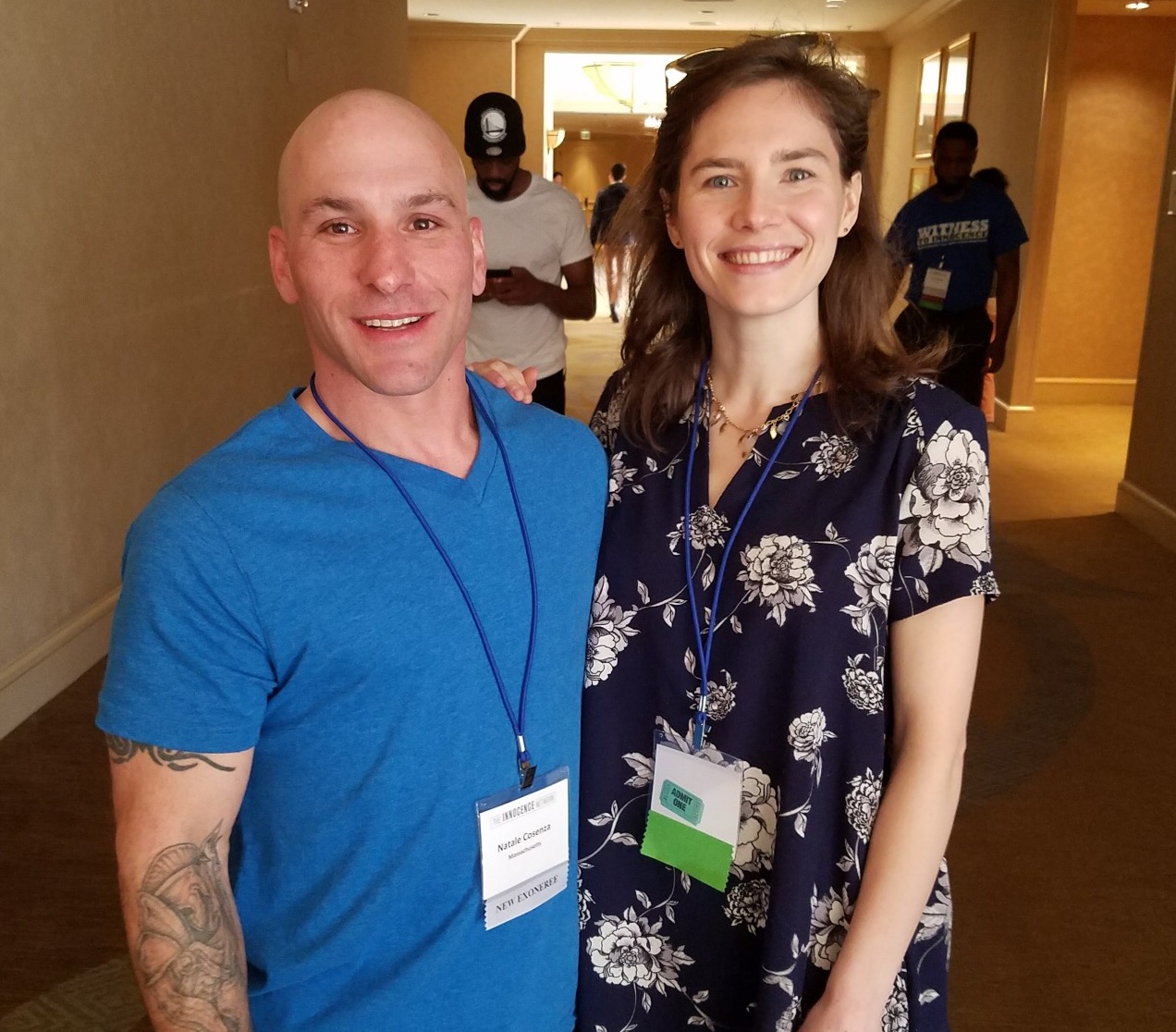
Nat with exoneree Amanda Knox.

Nat with exoneree Amanda Knox.

Nat also took part in The Moth workshop, which offers the wrongfully convicted (and their advocates) a chance to craft and hone a 5-minute story which they then present to the conference attendees (who numbered nearly 1,000.)  Nat presented his story, as did Ronjon and Sean.

“When I did The Moth, it was the first time that I’ve really spoken about what I’ve been through,” Nat said. “It was gratifying, and also kind of a relief to talk about. I’ve had so many emotions locked inside, and it was really good for me to get some of them out there.”

Despite the conference being just a whirlwind 2 days, Nat met people with whom he formed a strong and lasting bond: “I became very close with three individuals, students from Texas and Canada. It was amazing how close we became in such a short time. That’s really, really rare for me.” 

Returning to the outside world after being released from years of incarceration isn't an easy process, to say the very least. Having the opportunity to be welcomed into a community of individuals who can understand what you've endured in a way that the rest of us simply can't is incredibly important, and we're so grateful to the donors who enabled us to bring all five of these incredible Massachusetts men to the conference. 

Scrutinizing America's Guilty Plea Problem

When Johnny Vargas was pulled over for an incomplete stop in Massachusetts, police noticed a strange package on the passenger seat. Upon opening it, they found a brick of cocaine. Vargas vehemently insisted that he had never seen the package before, but when faced with a possible 15 years in prison for cocaine trafficking, he pled guilty, and in exchange received a sentence of just 7 years. He was exonerated after it came to light that the drugs had in fact been planted in his car.

For most of us, the concept of pleading guilty to a crime you didn’t commit seems impossible to comprehend. We assume that the innocent always have a chance to argue their case before a jury of their peers, when in fact our system is predicated on plea deals, making trials a relative rarity. Roughly ninety-seven percent of federal convictions and ninety-four percent of state convictions are the results of guilty pleas.

The Innocence Network, in collaboration with the Innocence Project, are launching the Guilty Plea Problem campaign today in an attempt to address the phenomenon of innocent people being forced to plead guilty. In New England, there have been 4 documented cases of innocent people pleading guilty. The phenomenon is almost certainly worst at the less serious end of the sentencing spectrum, in misdemeanor courts where almost every defendant pleads guilty.

"There are powerful incentives for people to plead guilty, even if they are, in fact, innocent," says NEIP Senior Staff Attorney Radha Natarajan. "When faced with charges, told there is enough evidence to convict, and warned of all the potential consequences -- including immigration, housing, family, and freedom -- the pressure is often too much for people to choose a trial.  This is true even when the evidence the prosecution is relying on is tainted, such as in the over 20,000 cases touched by notorious Massachusetts chemist, Annie Dookhan."

The New England exonerees who had taken guilty pleas (detailed below) are, sadly, the lucky minority.

Cheryl Adams was working as a cashier at a Cumberland Farms in Massachusetts when a loss-prevention worker accused her of stealing from the register. Confused, Adams denied all of the charges — until her interrogator, knowing that Adams was embroiled in a contentious divorce, warned her that she could lose custody of her son if she refused to sign a confession. After hours of interrogation, she eventually signed a confession stating that she had stolen over $10,000.

In 1990, a Boston man stopped a young girl at knifepoint, dragged her behind a dumpster, and fondled her. Minutes after the crime, police stopped Guy Randolph, a diagnosed schizophrenic, and asked the victim if Randolph was her attacker. She initially denied that he was, but later in the day identified him. She testified in court that Randolph was her attacker (despite much contradictory evidence) and Randolph’s lawyer convinced him to plead no-contest.

Bobby Johnson, a then-16 year old with limited intellectual capacity, was arrested for involvement in a fatal shooting in New Haven, Connecticut. The detective interrogating Johnson falsely informed him that they had found physical evidence linking Johnson to the murder, and, after hours of interrogation without either parent present, Johnson finally broke down and falsely confessed to his involvement in the murder.

People take plea deals for a variety of reasons, and plenty of those who plead guilty are, in fact, guilty. The problem is that the promise of reduced charges in exchange for a plea is presented to both the guilty and the innocent, setting the goal to the illusion of justice, instead of the actual realization of it.

 “The lack of available resources in the system incentivizes a culture of innocent people pleading out. In order to address wrongful convictions we need to work towards changing this culture, which would undoubtedly require increasing resources or decreasing arrests," says New England Innocence Project Executive Director Denise McWilliams.

Join us in working to end innocent people being forced to plead guilty to crimes they didn’t commit — a phenomenon which leaves the real perpetrators free to commit more crimes, and serves to enforce a mere illusion of justice in the United States.