
As part of an ongoing effort to uplift the leadership and voices of women of color in Greater Boston, The Boston Foundation and Boston Women’s Fund has announced the fifteen nonprofit leaders who comprise the 2022 Anna Faith Jones & Frieda Garcia Women of Color Leadership Circle, including NEIP Executive Director, Radha Natarajan.
The Circle is a six-month cohort program that seeks to honor the leadership, strength, and resilience of women of color who do incredible work within their communities and provide them with a cherished space to share challenges and opportunities.
“Undisclosed” Podcast Features NEIP Client
Season 6 of the Podcast “Undisclosed” Features NEIP Client, Jason Carroll
The State vs. Jason Carroll

Our client, Jason Carroll, was wrongfully convicted of murder in New Hampshire. Based on a false confession, one of the leading causes of wrongful convictions, Jason has now spent nearly 32 years in prison for a crime he did not commit. No one in NH has ever been exonerated after a murder conviction. We are fighting for Jason Carroll's freedom and exoneration. Attorney Rabia Chaudry covers the case in Season 6 of the Undisclosed Podcast, the State vs. Jason Carroll. Listen to Season 6 of Undisclosed and look out for updates on Jason's case.
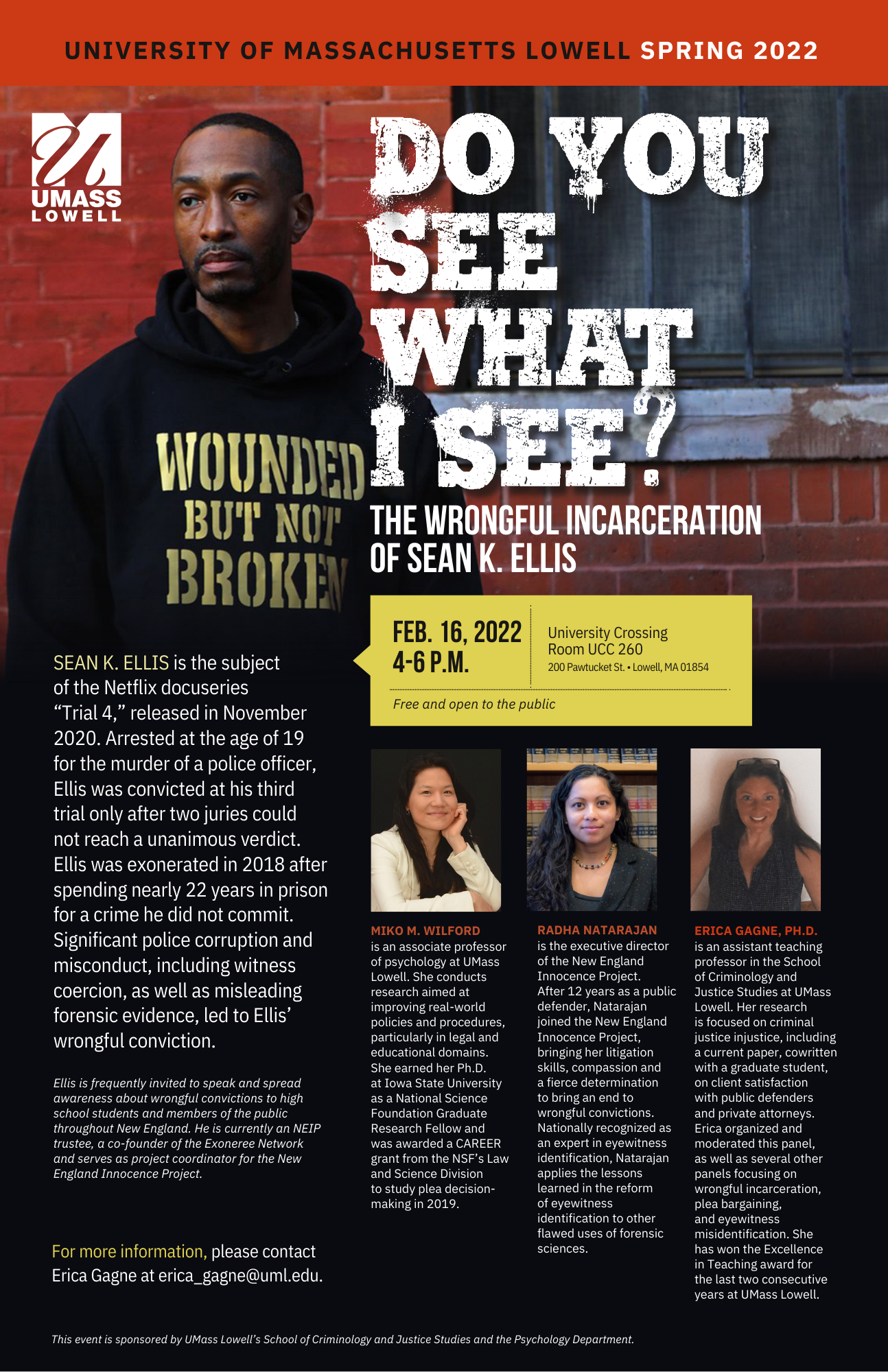
Sean Ellis to Participate in Panel Discussion at UMass Lowell
“Do You See What I See? The Wrongful Incarceration of Sean K. Ellis”
Wednesday, February 16, 4 - 6 p.m.
WHEN: February 16, 4 - 6 p.m.
WHERE: University Crossing, Room UCC 260, 200 Pawtucket St., Lowell, MA 01854
ABOUT: University of Massachusetts Lowell is hosting a panel discussion featuring exoneree and NEIP Trustee, Sean K. Ellis, as well as NEIP Executive Director, Radha Natarajan; Miko M. Wilford and Erica Gagne, PH.D. of UMass Lowell
Event is free and open to the public
A new year in freedom
Exoneree Robert Foxworth reflects on his first year of freedom
and shares hope for the year ahead

“This past year was my first year in freedom after almost three decades in prison for a crime I did not commit. When the state of Massachusetts finally ordered my release, they merely opened the prison doors and said ‘you’re a free man’. For nearly 30 years, while I was wrongfully in their custody and under their control, they held the obligation of providing for my basic needs. In fact, if I had died in their custody, the state would have buried me. Yet upon my release, they offered no assistance in getting my life back on track. I was released in the middle of a pandemic, so jobs were not available. Income to buy food, clothing, and any necessities just wasn't there. How could the state concede that I’d been wrongfully convicted, wrongfully taken from my family for almost 30 years, yet offer me no help?
Thanks to my attorneys, my community, and to my family, I survived. Not everyone is so lucky. And while this first year was hard and painful at times, it was also quite beautiful. I've met people who mean the world to me. To them, I want to say thank you and I love you.
As I enter a new year in freedom, I hope to see the New England Innocence Project, and all of those who work tirelessly to help people like me, keep up their diligence and determination to get those who are wrongfully convicted released from prison. I truly celebrate when someone in our community finds freedom, because I know their situation all too well. For years I told anyone that would listen that I was wrongfully convicted. For so long, my words fell on deaf ears.
So while the New England Innocence Project keeps up their fight to right these wrongs, I will fight right beside them. I honor and respect all that they do on behalf of everyone they fight for.”
— Robert Foxworth,
Exonerated in January 2021
Hear more from Robert: Watch the video
Learn more about the peer-led Exoneree Network, which provides much needed support to exonerees in New England as they work to rebuild their lives in freedom.
Giving Tuesday Special Offer: Receive an Origami Gift
Thank you to all who donated to this campaign!
Giving Tuesday is November 30, a global day of giving, and
we're honoring the day in two very special ways:

First, donate $100 or more by midnight on Giving Tuesday, November 30 and you will receive an origami crane or wolf (pictured above) handmade by exoneree, Scott Hornoff. Inspired by the Japanese tradition and honoring the history of folding paper for symbolism and hope, Scott saw courage and freedom in these special animals during his wrongful imprisonment. Below, read how origami became a part of Scott's fight to overturn his conviction.
Second, Giving Tuesday is the official launch of our year end MATCH campaign! Thanks to a generous donor, all donations made from November 30 through December 31, 2021 will be DOUBLED (up to $25,000) dollar-for-dollar for twice (2X) the impact.
Learn more about Scott’s story, how he discovered origami, and the symbolism of the crane and wolf below.
Scott’s Story
Envisioning Freedom Through Origami
"In 1996, without any witnesses or evidence linking me to the crime, I was tried and convicted of first degree murder, and sentenced to life in prison for a crime I did not commit. I was scared, in shock and numb. I knew my fight for truth and freedom was going to take years, and I knew I was going to have a lot of time on my hands. Besides writing thousands of letters asking for help and spending countless hours in the law library researching my case and helping others, I read hundreds of books, wrote a screenplay, poems, and taught myself to draw, but one of the first things I did was learn to fold origami.

I purchased a book of origami through a popular inmate bookselling company (Edward R Hamilton), and the two folds that I gravitated towards were the crane and the wolf. The wolf symbolizes courage, strength, perseverance and freedom. The crane reminded me somewhat of a phoenix, and I imagined myself ultimately spreading my wings and rising out of the fire and ashes of my confinement. I mailed many to family and friends, and even gave a few to other inmates.
Since my release and exoneration in 2002, I have revisited my book of origami from time to time and folded cranes and wolves, recalling the time I sat on my prison bunk doing that very thing for hours. Recently, a thought came to me of how I might share this art with others while also helping some of my heroes, the New England Innocence Project. This is my small way of trying to give back to a group of people who tirelessly fight for others' freedom and to prove their innocence when they have been all but forgotten."
- Scott Hornoff, Exoneree
Join us for Voices of the Innocent: Amplify!

Lift your voice against injustice!
Mark your calendars and tune in virtually on October 28 at 7 PM for Voices of the Innocent: Amplify!, a special virtual event featuring the stories and perspectives of those directly impacted by the tragedy of wrongful convictions. We’ll recognize local champions who fight tirelessly on behalf of innocent individuals and come together as a community to demonstrate our commitment to racial justice and meaningful change in the criminal legal system.
Funds raised through this event will directly support the work of the New England Innocence Project by providing free forensic testing, investigation, experts, and an experienced legal team to exonerate the innocent and bring them home to their loved ones. With your help, we can also provide support to exonerees as they work to rebuild their lives in freedom, and use our expertise to educate and advocate for systemic change to prevent future tragedies.
We look forward to sharing with you all that we have accomplished, and can accomplish, together.
Immediately following the formal event, please join us for a community conversation with Massachusetts exonerees, Sean Ellis, Robert Foxworth, and James Watson. Moderated by Phillip Martin of GBH News Center for Investigative Reporting.

Wrongful Conviction Day 2021

Thank you for joining us!
Wrongful Conviction Day Rally & March
Saturday, October 2, 2021
View the video from our 2021 event!

Thank you to everyone who raised their voice with us at the Wrongful Conviction Day Rally & March on Saturday, October 2 on Boston Common as we confronted the myths and challenges we face in the criminal legal system, supported ending life without parole sentencing, and lifted up ongoing efforts to overturn convictions.
Guests and guest speakers included exoneree Robert Foxworth, State Representative Liz Miranda, a spoken word performance by Michelle Garcia Fresco, drum beats by Grooversity, and much more. Stops along the march included the State House and the John Adams Courthouse.
“The Fight Continues…” was the theme of this year’s International Wrongful Conviction Day. During our Rally & March, we invited family members, loved ones, lawyers, and anyone else engaged in the fight for freedom with people who are incarcerated, to lift up an image of that person and say their names. This demonstration recommits our community to continue this fight together.
It takes a movement to overturn even one wrongful conviction, not to mention changing the system. Join us in our fight, not just for Wrongful Conviction Day, but every day.
A Celebration of Freedom and Community
#FreedomParty
We had an exciting and emotional day on Saturday, July 17, for our community! We gathered together in person for “A Celebration of Freedom and Community,” the first time we’ve been able to get together in a very long time. 14 wrongfully convicted people - 445 years in prison for crimes they did not commit. It was a beautiful afternoon full of love, energy, and heartfelt reunions. There’s more we need to bring home. We’ll continue the fight.


Photo Credit: Nicki Pardo
An Investigator's Story: A Search for Freedom
An Investigator's Story:
A Search for Freedom

By John Nardizzi,
Investigator

Pictured from left to right: Don Juan Moses, John Nardizzi, James Watson. James Watson was exonerated in 2020 after being wrongfully imprisoned for four decades.
My name is John Nardizzi and I’m an investigator. Investigating wrongful convictions with the New England Innocence Project is the most meaningful work I do. Our task is clear: Free an innocent person from prison. Yet, the entire legal system is built to keep innocent people in and to maintain and enforce these wrongs. The sense of injustice can be simply overpowering.
I was surprised to learn that the majority of criminal cases have no DNA to test. Many more cases, instead, require investigators like me to take on the more challenging work of demonstrating innocence through other evidence — interviewing new witnesses, finding missing or “lost” evidence, and proving police misconduct or that a witness lied at trial.
With your support, I am able to follow every lead, sometimes engaging 20 or more witnesses for just one case. Most witnesses talk. Some don't. But it only takes one to say, “I’ve been waiting 25 years to talk with someone like you about this” to break a case wide open. Hearing that gives an indescribable thrill. That’s when I know that one day our client may walk free.
Last year, we were able to provide essential investigative work that played a critical role in freeing people, including James Watson, who was exonerated in 2020 after being wrongfully imprisoned for four decades. Supporters like you made this possible.
Sad to say, there are many more people like Mr. Watson in prison in need of help. That's why, even during a global pandemic, my work could not stop. Right now, I am working on over a dozen wrongful conviction cases with the New England Innocence Project. Together, these innocent people have already spent over 200 years in prison for crimes they did not commit. Your support allows us to do the difficult investigative work that can make all of the difference for innocent people and their families.
Make a gift today and every dollar you give will be
matched (2X) until June 30, 2021 (up to $50,000).
This is grassroots work taking place right in your backyard — helping the most vulnerable people in your community. Will you consider giving a matching gift today?
Annual Impact Report
June 2020 - June 2021
Click below for an interactive PDF of our Annual Impact Report and learn more about
memorable moments and ways we have been making an impact over the last 12 months.
Annual Impact Report
Annual Impact Report:
June 2020 - June 2021
Click below for an interactive PDF of our Annual Impact Report and learn more about
memorable moments and ways we have been making an impact over the last 12 months.

New Hampshire Governor Signs Post-Conviction DNA Testing Bill
Wrongfully convicted people in N.H. now have
access to life-saving scientific evidence

By Cynthia Mousseau,
N.H. Staff Attorney

The New England Innocence Project works on the ground in six New England states. Each state has its own particular traditions and processes within its criminal legal system. What’s unique and surprising about New Hampshire is that there have been only two exonerations in the state’s history. We would love to believe that this is because N.H. has a flawless criminal legal system with perfect attorneys and judges. But studies show that a lack of official exonerations is not likely an accurate representation of the true number of wrongful convictions within a state. Once someone has been wrongfully convicted of a crime, it is a genuine uphill battle for freedom. They're often forced to pursue their cases on their own, without an attorney, and litigation can be daunting and confusing. Just the words “post-conviction litigation” would be enough to send many people in search of a dictionary. Adding science into the stew of legalese only serves to further muddy the waters.
Science changed the landscape of criminal trials with the advent of DNA testing in the 90s. DNA testing has been critical in many post-conviction cases: The National Registry of Exonerations reports there have been 376 exonerations involving DNA since 1989. Unfortunately, none of those exonerations took place in the state of N.H. Although N.H. adopted a law in 2004 that allows folks to apply for testing of DNA after they have been convicted, the law was extremely limiting. For example, only incarcerated people could apply for post-conviction DNA testing. And to do so, they had to prove a number of different facts, and submit their application within a certain time frame – and they had to do it all without the assistance of an attorney. These high burdens made it extremely hard for folks that were wrongfully convicted to prove their innocence through DNA testing after their convictions.
To fix these difficulties, the New England Innocence Project and the Innocence Project, Inc. recently drafted an amended version of the law, HB 270, making DNA testing more accessible to people who have been wrongfully convicted in the state. On Wednesday, N.H.'s governor signed the new and improved version into law. HB 270 significantly improves N.H.'s post-conviction DNA testing bill.
Some highlights from the amended law include:
the right to have an attorney to help people access and test DNA after they have been convicted of a crime;
making it easier to get the court to order DNA testing after a conviction;
expanding the availability for post-conviction DNA testing to people who are no longer incarcerated; and
clarifying that there was no statutory time limit on the filing of such a request.
One of the lessons we have learned from our DNA exonerations in other states is that if the laws allow it, innocent people’s cases can and will fall through the cracks. The new law fills in some of those cracks. By ensuring attorney involvement earlier on in the post-conviction process, we provide innocent people with a means of accessing guides in a foreign landscape. By changing the standard of proof and providing for discovery, we ensure that those that are innocent are given a fair chance to access life-saving evidence. By eliminating a timing requirement, we show that there is no expiration date for justice. We are so pleased to have partnered with our friends in N.H., especially Representative Renny Cushing and Representative Casey Conley, to make these important changes for the wrongfully convicted citizens of N.H.
Policy Change through the Courts
Policy Change through the Courts
A Reflection on the Amicus Work
of the New England Innocence Project 2020-2021

By Radha Natarajan,
Executive Director

Impacting policy and systems is a vital part of the mission of the New England Innocence Project (NEIP) and has fueled our strong amicus practice. We weigh in on cases where the issues at stake impact the people we serve, such as racial justice, reliability of evidence, presumption of innocence, official misconduct, the administration of justice, and the list goes on. Many people think of policy work as the work that happens in the legislature, and it certainly includes that; however, amicus work is policy work too, using litigation tools to inform judicial policy that can create systemic change.
In Latin, amicus curiae means “friend of the Court.” As an organization committed to exposing failures of the criminal legal system, it may seem counterintuitive that we would so often play the role of “friend of the Court,” but I suppose it depends on how you characterize friendship. We are decidedly not the placating type of friend, affectionately praising or celebrating the Court’s wisdom or history. Instead, we aim to be the friend who is authentic and honest, adding a perspective that might otherwise be missed, and who will hold our “friend” (the Court) accountable to its highest vision of itself. Our friendship, defined in this way, has been consistent and persistent over the last year, and includes these highlights among many:
Race and Policing: With the Massachusetts Association for Criminal Defense Lawyers, Lawyers for Civil Rights, and the Charles Hamilton Houston Institute for Race and Justice at Harvard Law School (CHHRJ), we sought an overhaul of the Court’s approach to the significant racial disparities in traffic enforcement. The Court’s decision in this case, if faithfully applied, has the potential to breathe life into the Equal Protection Clause, ensuring that implicit and explicit racial biases resulting in individual and community harms to people of color are neither sanctioned nor ignored. Commonwealth v. Edward Long
Reliability of Technological and Identification Evidence: With CHHRJ, we addressed the injustice of this conviction that was based on unreliable, suggestive, and racially biased evidence. Here, critical evidence that the prosecutor used to convict Mr. Davis - speed data from a GPS device - had never been tested for its accuracy, even by the manufacturer. In addition, the prosecutor urged the jury to identify Mr. Davis from a blurry image in which you could not even make out the person’s face. The Court reversed Mr. Davis’s conviction and affirmed that it is a prosecutor’s and the court’s duty to ensure the reliability of evidence used to take away someone’s freedom. Commonwealth v. Matthew Davis
Police Misconduct: With the Innocence Project and the Boston College Innocence Program, we are seeking a comprehensive and independent investigation of misconduct by the Springfield Police Department. Specifically, after the Department of Justice found widespread abuse and falsification of evidence within the Springfield Police Department, the Hampden County District Attorney’s Office has neither investigated the scope of that misconduct nor disclosed it to people whose cases may have been affected. To prevent and correct wrongful convictions, as well as confront racial disparities, we supported the Petition requesting the Court’s intervention. Graham et al., v. District Attorney of Hampden County
I am incredibly proud of NEIP’s amicus work, and I am indebted to the pro bono partners who have represented us in this work as well as the coalition partners who have been steadfast about their commitment to transformative, not only incremental, change.
As an organization whose staff and supporters have witnessed significant injustice alongside our community, we are committed to speaking out and demanding better from an institution that is supposed to ensure justice for all. Our amicus work is just one of the ways that we amplify those demands, and with the impact we have achieved, we intend to keep it going.
Sean K. Ellis Exonerated of Remaining Wrongful Conviction
Superior Court Justice Allows Sean Ellis’s Motion for New Trial on Firearms Offense
UPDATE 5/6/21: This week, Suffolk County DA Rachael Rollins’ office filed a nolle prosequi, officially dropping the charges and fully exonerating Sean Ellis.
BOSTON, Mass. [May 4, 2021] – Today, Superior Court Associate Justice Robert Ullmann allowed Sean Ellis’s Motion for New Trial on the gun conviction remaining on his record from his wrongful conviction for the 1993 murder of Boston Police Detective John Mulligan, which was overturned in 2015 after Mr. Ellis spent more than 21 years in prison for a crime he did not commit.
Attorneys Rosemary Scapicchio and Jillise McDonough filed a motion for new trial on the gun conviction on December 9, 2020. On March 17, 2021, District Attorney Rachael Rollins filed her agreement with that motion, stating (among other things) that "[c]orruption at the root tainted every branch of the investigation into Detective Mulligan's murder, including the gun possession charges." The District Attorney said that if the Court allows the motion for new trial, her office will file a nolle prosequi, ending the prosecution of the case.
Judge Ullmann gave his decision orally, stating “This whole case is a very sad chapter in the history of the criminal justice system. Thankfully, this chapter seems to be nearing its conclusion.” He indicated that “justice was not done” in this case because exculpatory evidence that might have changed the outcome of Mr. Ellis’s trial was not provided to him.
Attorneys Scapicchio and McDonough stated, “We are grateful to Judge Ullmann and to DA Rollins for acknowledging so clearly that with withholding of exculpatory evidence results in an unjust trial. Here the actions of the Boston Police in actively concealing their corruption and withholding evidence resulted in Sean Ellis serving 22 years of a life sentence for a crime he did not commit. It took 29 years to get here, but never once, did we waiver and justice prevailed.”
Sean Ellis is the subject of the Netflix docuseries, Trial 4. Since his release from prison, Sean has made significant contributions to his community, working at Community Servings, a Boston nonprofit, serving on the Board of Trustees of the New England Innocence Project, and leading the charge to provide resources to others wrongfully convicted through the Exoneree Network, a collaboration between the CPCS Innocence Program, the Boston College Innocence Program, and the New England Innocence Project.
Wounded But Not Broken, by Sean Ellis
Wounded But Not Broken
By Sean Ellis, exoneree and NEIP Trustee

Photo credit: Boston Globe
My name is Sean Ellis and I was wrongfully convicted and imprisoned for nearly 22 years for a crime I did not commit. I've been through a horrendous ordeal and as a result, I have been deeply hurt. I have been vilified in the public eye, I have suffered injuries, I have suffered pain, and I have suffered tremendous loss. However, despite this grave injustice, I refuse to be broken. I am unwilling to allow these trials and tribulations to define who I am or put me in a space of inertia or defeatism. This concept of being wounded but not broken isn't isolated to those who have suffered at the hands of the criminal legal system; it encompasses those who have endured whatever hardships that life has thrown at them and have pushed back against it, refusing to let it crush them, and sought a path toward healing.
How does it feel to still be fighting for some semblance of justice after nearly 30 years?
As I await the Court’s ruling on my motion to overturn my wrongful convictions, I am reliving everything I’ve experienced while fighting this case for more than 28 years. During that time, I lost so much: My dad died, my firstborn nephew died, my next door neighbor died, two very close aunts (both of whom I grew up with) died, my best friend died, and my mother was diagnosed with cancer. They all lived in Massachusetts, but I wasn’t allowed to attend their funerals. The Department of Corrections didn’t allow it because of the Life Without Parole sentence that I was serving. This not only speaks to the inhumaneness of such a sentence, but it also speaks to the trauma and harm I’ve endured at the hands of the Boston police department and the criminal legal system. When I think about the impact this wrongful conviction has had on my life, I can’t help but think about some of these things, along with the fact that while my mom continues to live, she has more years behind her than she has in front of her. While my loved ones are happy to have me home, I can’t help but think about the detrimental psychological effects of incarceration, which have negatively impacted the quality of the relationships that I have with my siblings. I am able to keep fighting because, though I am wounded by all of these losses, I remain unbroken.
What would it mean to be fully exonerated of all your wrongful convictions?
I know all too well that the Commonwealth is not usually in the business of pursuing justice, nor are they in the business of exonerating people. They are in the business of obtaining and sustaining convictions at all costs. If this was not their standard operating procedure, I would have never spent a day in prison for a crime I did not commit. I would have been released in 1998 when the information my attorneys and I were seeking (but the former DA’s office withheld) resulted in the arrest of the low-level players in the corruption scheme. I would have been released when it was learned that in 1994, a year after the murder of Detective Mulligan, there was a simultaneous investigation underway into the conduct of the detectives on my case, Detectives Acerra, Robinson, and Brazil. I would have been released once it became known that Detectives Mulligan, Acerra, Robinson, and Brazil, along with their supervisor, were present and participated in the kidnapping and robbery of local drug dealers just days before Detective Mulligan’s murder. The former police commissioner knew the victim was involved in corruption and still placed this cadre of dirty cops amongst who he called “the best and the brightest.” Remember these names…Acerra, Robinson, and Brazil…they infected every aspect of the Commonwealth’s case against me, from the murder to the armed robbery, and right on down to my remaining firearm charges. They cannot be parsed apart.
So, when I think about a full exoneration, I first have to divorce myself from the reality of what I know and have experienced personally. What I can and will say is that for someone to exonerate Sean K. Ellis, the person making that decision has to be of such extraordinary character that they’re willing to go against the status quo in order to do what is right and what is just! I say extraordinary character because racism and biases exist within the criminal legal system. Both racism and biases exist within the Office of the District Attorney. Judge Ball exonerated me when she said that “justice was not done” and the Supreme Judicial Court exonerated me when they affirmed Judge Ball’s decision and referred to the revelations of the withheld evidence, specifically the involvement of Detective Mulligan in the corruption, as a “game-changer.” I am grateful DA Rollins brought the fortitude and integrity of her life experiences with her to the Office when deciding to assent to my motion for new trial. I hope that the Court will agree and allow the DA’s office to drop the charges, as they have committed to do, so I can move on with my life.
Why is public acknowledgment of mistakes or injustice so important for people who have been wrongfully convicted?
Public acknowledgment is so important to the exoneree (depending on who you ask) because, as it was in my case, I was vilified in the public eye. I was vilified to a group of 16 people, 12 of whom decided my fate. That group of 12 people were given a false narrative and, as a result, they wrongfully convicted me. I was sentenced to spend the remainder of my natural life in prison based on this false narrative. A public acknowledgment of mistakes and wrongdoing is equally as important, if not more important, for the proponent of the false narrative, because it’s an opportunity for them to take a step toward justice and say, “Wait, I am not ok with this and I’m not going along with the wrong that was done to this individual.”
Public acknowledgement of injustice in my case is also vitally important because there has been an admission of wrongdoing on the part of the Boston Police Department. Therefore, there should be an investigation, not just into my wrongful conviction, but all convictions involving the Boston Police Department obtained during the years these corrupt officers were on the force.
As a community, it is our responsibility to fight to ensure that police departments, in particular, and DA’s Offices are operating with transparency and accountability. Despite how formidable they are, you have the right and the capacity to fight injustices perpetuated by these departments, and we all stand with you in that fight.
Sean is a motivational speaker, and a staunch advocate of criminal justice and prison reform. He is a co-founder of the Exoneree Network and serves as a Trustee on the board of the New England Innocence Project. Sean is a recipient of the 2021 Boston Mountaintop Award for advocacy related to Black innocence within the criminal justice system. Sean’s recently released Netflix Docu-Series, Trial 4 has elevated his voice internationally as he continues to speak about his experiences with racism and injustice within the criminal justice system. Learn more about Sean’s story at www.TrialFour.com.
-----
Learn More
The Law Offices of Rosemary Scapicchio, the New England Innocence Project, and the CPCS Innocence Program hosted a virtual press conference March 17 in response to District Attorney Rachael Rollins filing in Court assenting to the motion for a new trial for the remaining gun convictions for Sean Ellis. Watch the press conference video below or click here.
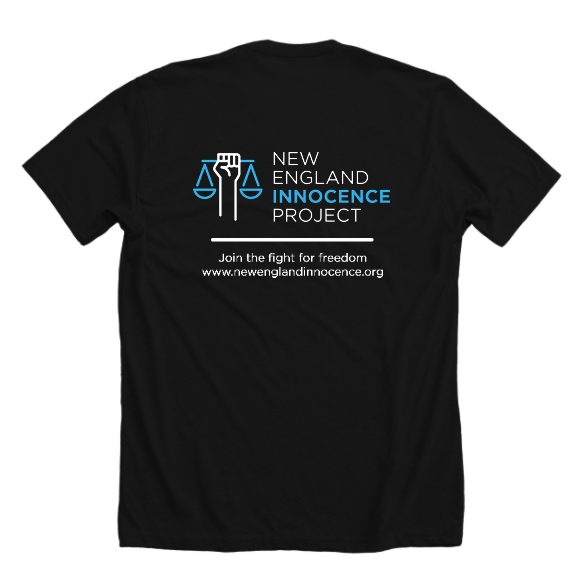
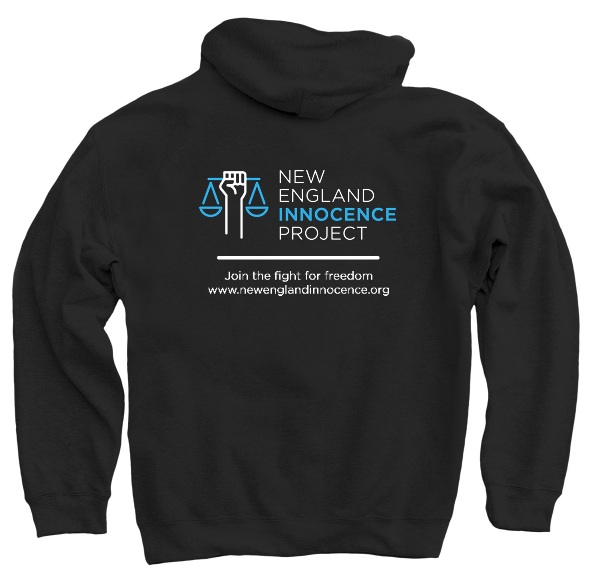
* Edit: Limited edition shirts no longer available*
SHOP OUR LIMITED EDITION “Wounded but not broken” NEIP apparel,
inspired by a Sean Ellis original design
Available until May 16 only!
All proceeds will go to support the work of the New England Innocence Project,
including the work led by exonerees.


Racially Charged: A Film Screening & Conversation
Reserve Your Spot:
April 20 at 6:00 p.m.

Join us on Tuesday, April 20, from 6:00 - 7:35 p.m. for a special screening of the short film, "Racially Charged: America's Misdemeanor Problem" and post-screening community conversation with local leaders from the New England Innocence Project, Charles Hamilton Houston Institute for Race & Justice, and the ACLU of Massachusetts.
This film exposes how our country’s history of racial injustice evolved into an enormous abuse of power using the criminal legal system. 13 million people a year – most of them poor and people of color – are abused by this system. Through first-person accounts of those charged under the Black Codes of the Reconstruction era paralleled with the outrageous stories of people trapped in the system today, the film brings to light the unfolding of a powerful engine of profits and racial inequality. With the emergence of the Black Lives Matter movement, this film provides historical context and examines America’s history of racist oppression.
Conversation and Audience Q&A
Moderated by David Harris, Managing Director of the Charles Hamilton Houston Institute for Race & Justice, the film screening will be followed by a community conversation about how this abuse impacts our community on a local level with Radha Natarajan, Executive Director of the New England Innocence Project, and Rahsaan Hall, Director of the Racial Justice Program at the ACLU of Massachusetts.
D.A. Rollins Files Assent to Motion for a New Trial for Sean Ellis
D.A. Rollins Files Assent to Motion for a New Trial for Sean Ellis,
Provides Next Step Toward Justice After Wrongful Conviction
Sean Ellis and His Attorneys React to the Filing in Press Conference;
Ellis Served 22 Years in Prison for a Crime He Did Not Commit
WHAT: The Law Offices of Rosemary Scapicchio, the New England Innocence Project, and the CPCS Innocence Program hosted a virtual press conference TODAY, March 17, at 1:00 p.m. in response to District Attorney Rachael Rollins filing in Court today assenting to the motion for a new trial for the remaining gun convictions for Sean Ellis of Boston, a long-awaited step toward justice for Ellis.
On December 9, 2020, Sean Ellis and his attorneys, Rosemary Scapicchio and Jillise McDonough, filed a motion for new trial to overturn the gun convictions remaining on his record from his wrongful conviction for the 1993 murder of Boston Police Detective John Mulligan, which was overturned in 2015 after Ellis spent more than 21 years in prison for a crime he did not commit. Ellis is currently a member of the Board of Trustees at the New England Innocence Project and is the subject of the Netflix docuseries, Trial 4.
In DA Rollins filing, she stated (among other things) that "[c]orruption at the root tainted every branch of the investigation into Detective Mulligan's murder, including the gun possession charges." The District Attorney said that if the Court allows the motion for new trial, her office will file a nolle prosequi, ending the prosecution of the case.
Media Coverage
GBH: “DA Rachael Rollins Endorses New Trial To Vacate Sean Ellis' Gun Conviction”
GBH, Greater Boston: “Suffolk D.A. Rachael Rollins On Moving To Drop Sean Ellis’ Final Gun Charge”
Boston Globe: “Suffolk DA Rollins files motion to end the long-running prosecution of Sean Ellis”
WBUR: “Rollins Seeks To Erase Sean Ellis' Firearm Convictions”
WHDH: “Suffolk DA Rollins files motion to end decades-old case against Sean Ellis”
About the Law Offices of Rosemary C. Scapicchio
Rosemary Curran Scapicchio is an experienced criminal defense attorney based in Boston. The important work she does on behalf of her many criminal law clients is based on one belief: that the serious charges against her clients require dedication and aggressive advocacy to win their freedom and reunite them with their families. She has successfully defended many clients nationwide in recent years. Her dedication to giving aggressive advocacy in every case is evident in the number of not-guilty verdicts she is able to secure for her clients.
About the New England Innocence Project
The New England Innocence Project (NEIP) is an independent social justice non-profit committed to correcting and preventing wrongful convictions and fighting against injustice within the criminal legal system for innocent people imprisoned for a crime they did not commit in Massachusetts, Connecticut, Maine, New Hampshire, Rhode Island, and Vermont. Our team provides free forensic testing, investigation, experts, and an experienced legal team to exonerate the innocent and bring them home to their loved ones. We provide exoneree support as they work to rebuild their lives in freedom through the peer-led Exoneree Network. We also use our expertise about wrongful convictions to provide education and advocate for legislative and judicial reforms to prevent future tragedies. For more information, visit NewEnglandInnocence.org.
About CPCS Innocence Program
The CPCS Innocence Program is a unit within the Private Counsel Division of CPCS that is responsible for identifying, litigating, and overseeing counsel assignments in all post-conviction cases in which an indigent Massachusetts defendant asserts factual innocence of the underlying crime and/or seeks post-conviction forensic analysis to support a claim of factual innocence. The Innocence Program aims to identify and fight to overturn wrongful convictions across the state of Massachusetts. Staff and panel attorneys represent indigent state defendants who have been convicted and punished for crimes they did not commit. The program accepts both DNA and non-DNA based innocence claims, with special attention to cases involving eyewitness identification, flawed or invalidated forensic science, false confessions, and police and prosecutorial misconduct.
New Year, Renewed Hope

It is a new year, with a new administration and new hope for an end to a pandemic that has harmed so many in our community. At the same time, today marks the first day of Black History Month, a time to reflect on the historical struggle for freedom and equality with the recognition that the struggle is far from over.
Nowhere is the unfulfilled promises of freedom and equality more apparent than in the criminal legal system, where wrongful convictions disproportionately devastate Black individuals, families, and communities. While only 8.1% of the New England population identifies as Black, 34.4% of New England exonerees are Black. And we know that this number, demonstrating the disproportionate number of Black people exonerated, represents only a fraction of those who were actually wrongfully convicted.
This Black History Month, like every other month, we confront and work to dismantle the legacy of – the straight line from – slavery to our criminal legal system. We recognize the impact – the collective trauma – of overpolicing in communities of color, the unjust criminalization of Black youth, and a legal system that ensures the presumption of innocence to only a select few.
We name these examples of harm so we may resolve to change them. Together, we will continue to work to free people from prisons as well as demand changes to the system that made their wrongful convictions possible. We will amplify the voices of those directly impacted, those like Sean Ellis, James Watson, and Keyon Sprinkle.
After all, as Amanda Gorman so beautifully reminded us, “There is always light, if only we’re brave enough to see it, if only we’re brave enough to be it.”
Injustice is not inevitable.
Together, let’s be the light that frees people in New England.
Thank you for being part of our community.

Support the Exoneree Network

Together, we've accomplished so much in the past year. And, as our community of freed people grows, so does the need for immediate and long-term support as they work to rebuild their lives after an unimaginable injustice.
We are excited to announce that, thanks to supporters like you, we've already succeeded in reaching our December "Triple Match" campaign goal. This is the first year we have met our goal so quickly. Therefore, in honor of this new initiative, all donations made today through December 31 will go directly to fund the Exoneree Network, led by and for exonerees.
Your generous gift will make an immediate impact by providing much needed resources, psychological support, and job training for freed people throughout New England.
We are truly excited to see what hope, power, and joy this initiative brings in 2021 and beyond. Whether you've already donated or have yet to make a gift, we thank you for helping us change lives and fight against injustice.

TRIPLE MATCH: Give the gift of freedom

"Freedom is Everything..."
You Make it Possible
Enjoy a brief look into our virtual event video and hear why our work is so important right now.
This year has been a challenging one. We have come together despite isolation, we have altered our lives to protect each other from sickness, we have risen up to protest racism and police violence, and we have worked harder than ever to free people from prison where the risk of contracting COVID-19 remains perilously high and infection rates are soaring.
Today, on Giving Tuesday, in response to this unprecedented need, we are launching our first-ever TRIPLE (3X) match campaign. Thanks to a generous supporter, we will TRIPLE any donations (through December 31) for three times the impact.
To everyone who has given so generously to our work, we thank you. Your gift is already being put in action supporting exonerees through our Exoneree Network, through advocacy and educational campaigns, and through litigation and investigation for our clients who are still awaiting justice. Sadly, there is still more work to be done.
Give today through December 31, and your gift will go three times as far (every $1 = $3) up to $25,000. Freedom means everything to people who have been wrongfully convicted. Without your support, freedom is just a dream. With you, it can be a reality.
Watch the Event Video
"Voices of the Innocent: Power in Community"

To everyone who could join us, thank you for attending our first-ever virtual event, Voices of the Innocent: Power in Community, on November 19. It was a deeply inspiring evening and our hearts are full of gratitude for our incredible (and powerful!) community of supporters. Thank you!
If you weren't able to attend, want to watch it again, or share it with friends, you can view the event online, and watch video of our post-event Community Conversation with exoneree and Trustee, Sean Ellis; exoneree, Keyon Sprinkle; Executive Director, Radha Natarajan; and State Representative, Liz Miranda.
Watch the full virtual event | Watch the Community Conversation

Sean Ellis, New England Innocence Project Trustee, Featured in Netflix's Trial 4
Trial 4, an eight-part Netflix Original docuseries, tells the story of Sean Ellis’s wrongful conviction for the murder of a Boston Police Officer. Sean was just 19 years old when he was arrested. It was only after three trials that Sean was convicted, but the evidence used against him was unreliable. Sean spent 22 years in prison for a crime he did not commit, working with his lawyer Rosemary Scapicchio to expose the police corruption, systemic racism, official misconduct, and faulty forensics that led to his wrongful conviction. In 2018, Sean was exonerated.

Live Panel Discussion
Watch panelists Sean Ellis, exoneree and NEIP Trustee; Attorney Rosemary Scapicchio, Devin McCourty and Jason McCourty of the New England Patriots, and D.A. Rachael Rollins as they discuss truths and myths about the criminal legal system, the role race plays in the system, and how we must come together to fight for justice. Moderated by Radha Natarajan, Executive Director of the New England Innocence Project.
Sadly, Sean’s story is not unique. It is just one example of the countless injustices happening every day to people throughout New England and across the country. Since Sean’s release from prison, he has committed his time and energy to raising awareness of the fundamental failures of the criminal legal system and to supporting his family and community. He has spoken locally and nationally about the impact of wrongful convictions and the importance of mobilizing for change. Sean joined our Board of Trustees and is the Project Coordinator for and co-founder of the Exoneree Network, an initiative funded by NEIP to support the practical, emotional, and spiritual reentry needs of exonerees. Sean is an essential and integral part of the exoneree community and of the New England Innocence Project. Watch Trial 4 to learn more about Sean’s story.
What Can You Do to Help?
Wrongful convictions are not isolated incidents or the result of a few bad actors, but an inevitable result of a system designed to enslave Black and brown people. Therefore, if we don’t fight to change the system that perpetuates these injustices, there will always be wrongful convictions and more stories like Sean’s.
Leave a note of support for Sean
In the comments below, we welcome you to leave a note of support for Sean and/or your commitment to work alongside us to fight against injustice.
Be an ambassador
Share stories about wrongful convictions like Trial 4, and the work NEIP is doing to free innocent people from prison, with your family and friends and have a discussion about it. Real stories of injustice have the power to change minds and open hearts; they reveal our common humanity and can spark a movement and we need your help to amplify them.
Subscribe to our e-newsletter
Stay up to date on NEIP news and events, exoneree stories, urgent policy calls-to-action and more by signing up for our e-newsletter.
Make a donation to the New England Innocence Project
If you are moved by what you have seen, support the work we do together to correct and prevent wrongful convictions and suppport exonerees upon their release by making a donation.